
Sentient GRID: technical and economic blueprint for decentralized AGI
Thread777 words
Bullish call$SENT−25%since listing, moved against the callHow it played out ↓Unpacks Sentient's GRID: expert workflows, recursive atomization and token-level routing as the orchestration layer, and SENT staking with emissions tied to usage as the economic engine. Frames AGI as a network of specialized intelligences.
Key claims
AGI market from $3B today to a projected $750B+ by 2032
GRID can route at token level between soft-skill and hard-skill models
SENT emissions directed by stake, expert reps and real usage
𝗚𝗥𝗜𝗗: 𝗔 𝗧𝗲𝗰𝗵𝗻𝗶𝗰𝗮𝗹 𝗮𝗻𝗱 𝗘𝗰𝗼𝗻𝗼𝗺𝗶𝗰 𝗕𝗹𝘂𝗲𝗽𝗿𝗶𝗻𝘁 𝗳𝗼𝗿 𝗗𝗲𝗰𝗲𝗻𝘁𝗿𝗮𝗹𝗶𝘇𝗲𝗱 𝗔𝗚𝗜
AGI, a.k.a. artificial intelligence that can match or exceed human performance across all cognitive tasks, represents the most transformative technology in human history.
It is poised to automate virtually all knowledge work and fundamentally reshape the global economy.
This unprecedented opportunity is accelerating rapidly with the AGI market exploding from $3 billion today to a projected $750+ billion by 2032, while the broader AI revolution could inject $15.7 trillion into global GDP by 2030 alone.
Tech leaders like Elon Musk, Sam Altman, and Demis Hassabis now predict AGI arrival as soon as 2026-2035, a timeline that has compressed from "50 years away" to "5 years away" in just four years, evidencing the massive advancements that are being made in this space.
But one question remains: How can you get exposure to this?
The main play I'm watching is @SentientAGI, which is building around a core thesis that truly resonates with me, and that poses a direct challenge to the prevailing narrative that AGI will emerge from a single, monolithic model.
In the eyes of Sentient, general intelligence will not be a singular entity, but rather a network of specialized intelligences collaboratively working together. A decentralized, composable system of agents, models, data, and tools.
Their framework for realizing this is the GRID (Global Research and Intelligence Directory), an ambitious protocol designed not only to be the technical orchestration layer for this network but, critically, the economic engine that makes it all sustainable.
Let me unpack this. ↓
➀ The Technical Orchestration Layer: A "Distributed Brain"
The GRID’s technical foundation is designed to manage and route intelligence with increasing levels of granularity, moving far beyond simple API calls to a single model.
A query is deconstructed, routed through dynamic workflows, and synthesized into a final output that leverages the best of the entire network. This is achieved through a multi-layered approach.
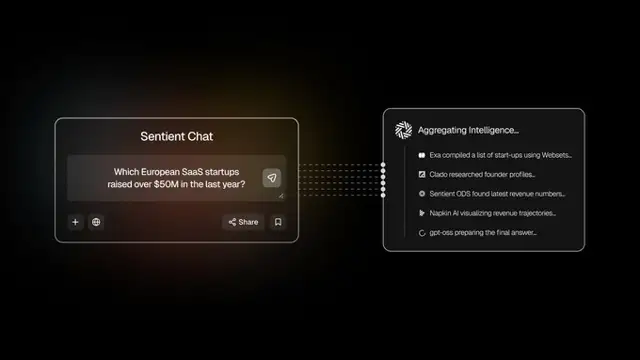
➤ Expert-Defined Workflows: For common, structured queries, the GRID utilizes expert-designed workflows that map out a logical sequence of steps. For a research query like, “Which European SaaS startups have raised over $50M in the last year?”, the workflow might involve sequential steps: initiating a web search, researching founder profiles, finding revenue metrics, and finally, aggregating the findings into a coherent answer.
➤ Recursive Atomization: For hyper-complex, novel queries, the GRID is evolving beyond static workflows. Its new architecture recursively atomizes a problem, breaking it down into the smallest possible "atomic tasks" required for a solution. Each atomic task is then routed to the most capable intelligence on the network, enabling the GRID to tackle problems of arbitrary complexity.
➤ Token-Level Routing: This represents the frontier of the GRID's orchestration capabilities. Instead of routing an entire query, the system can decompose it to the token, the smallest unit of AI language. As detailed in their "Dobby Report" (worth checking out as well), this allows for dynamic routing during generation. For instance, a query might be handled by a small "soft-skill" model optimized for tone, but when a factual piece of data is needed, the generation for just those tokens can be routed to a larger, "hard-skill" model. This technique produces outputs superior to any single model at a significantly lower computational cost.
➁ The Economic Engine: Solving the Open-Source Incentive Problem
This is the crypto-native core that makes the vision viable. The primary obstacle for open-source AI has always been the lack of a sustainable funding and monetization model, which the GRID is explicitly designed to solve.
➤ A Usage-Driven Meritocracy: The system is powered by the $SENT token. Holders can stake $SENT on network participants they believe are valuable, such as models, agents, or data providers. Token emissions are then directed based on a combination of stake, input from globally recognized AI experts ("reps"), and, most importantly, real-world usage and revenue.
➤ A Flywheel for Growth: This creates a powerful, meritocratic feedback loop. The most effective and widely used tools receive the most resources, rewarding builders for their contributions and attracting top-tier talent to the open ecosystem. The community, in turn, can collectively fund and scale the most promising open-source AI projects simply by using and supporting them.
What are the key takeaways?
The GRID's innovation lies in its dual-sided approach. It is not just a sophisticated agent framework. It's a complete, self-sustaining ecosystem with a crypto-economic backbone.
By integrating state-of-the-art technical orchestration with a robust incentive layer, Sentient is building the foundation for an AGI that is owned, governed, and scaled by its community.
DYOR anon, I don't think you want to miss this one.
Next up:
- OML
- Dobby
- ODS
- ROMA
Stay tuned.
3 more images on X
How the call played out · since 06 Oct 2025
Prices as of 23 Oct 2026This piece takes a view on $SENT, so that move is read against the call.
−25%
Moved against the call · since it listed on 23 Jan 2026, 4 months after this piece
- At listing
- $0.0297
- Now
- $0.0222
- vs BTC
- −18%
- After 1 month
- −25%
- After 3 months
- −30%
- High since
- +62% 01 Feb 2026
- Low since
- −61% 28 Jul 2026
Since then
Zero has written 6 more pieces on Sentient and $SENT since this one.
- Sentient SENT pre-market at $2.25B FDV vs seed valuation and peersBullish call on $SENT
- The Sentient Ecosystem and the Components of GRIDCovers $SENT
- Sentient ROMA: recursive task-tree agent framework hits 45.6% on Seal-0On Sentient
- ROMA: a recursive architecture for solving long-horizon AI tasksOn Sentient
Daily closes in USD from DefiLlama and Yahoo Finance. Only a bullish or bearish thesis is read as a call; explainers, maps and mentions are context. Not financial advice.