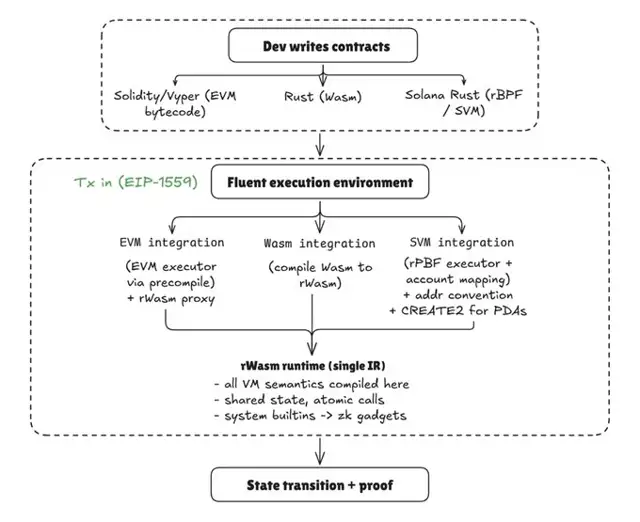
Fluent blended execution: EVM, SVM and Wasm compiled into rWasm
Quote840 words
Explains how Fluent compiles EVM, Solana rBPF and Wasm execution into one rWasm VM, so cross-VM calls are atomic and a single state transition is proven. Argues modularity should empower opinionated chains.
Key claims
EVM runs via precompiles and an executor contract behind an rWasm proxy
SVM programs run via a dedicated rBPF executor
One proof covers all VMs instead of separate proofs
Given a lot of recent post‘s around @fluentxyz‘s NFT sale from ppl that do not know or understand Fluent and complain about the NFT sale mechanics, wanted to share some additional context here:
As some of my (early) followers might know, I started my „career“ mainly talking about modular blockchain architectures, rollups, and the opportunities that this design philosophy enables.
They (Fluent) have been building for years, and I have been following their journey since long before they rebranded to „Fluent“ (they worked on same stuff before tho).
What always fascinated me within the „hey we’re a modular execution layer“ space, was the opportunity it provides to builders that want to build something truly different, without having to sacrifice Ethereum settlement as the final trust assumption or having to spend dozens of millions to build a „slightly faster“ Ethereum as standalone L1.
Modularity is meant to empower innovators, not copycats. Builders that want to build an OPINIONATED chain. A chain where things are possible that are NOT possible on a plain vanilla EVM chain and/or the base layer you’re anchoring on.
It’s honestly one of the reasons why I have always preferred the „network extension“ framing from the Solana ecosystem, vs. the „rollup-centric roadmap“ and „lets just build more EVMs on top of EVMs“ philosophy on Ethereum.
Bc like it or not, Solana was always quite vocal about the fact that they dont want or need a replication of Solana on top of Solana. App-specific logic that enables smth you cant do on the L1 is welcome, the rest is not.
But back to Fluent (which is building on Ethereum) and why I’m saying all of this:
Arbitrum filled a gap on Ethereum at a time it was truly needed, and is continuously trying to innovate beyond its basic perception of being „a cheaper Ethereum on top of Ethereum“ (which I like). Base entered the market with a distribution/liquidity edge through Coinbase (which is cool but bot that mind-blowing to me).
But what else is there in terms of L2s that actually makes a difference?
Mantle has been doing some cool stuff with its neobank, and with MegaETH + RiseChain we‘re getting realtime EVM execution layers that actually broaden the design space for builders.
That‘s rly cool stuff.
There is also some cool appchains like Paradex or Lighter too, which I appreciate as well, but that‘s pretty much it.
Fluent tho, completely aside their builder-centric approach in terms of building a community and ecosystem, and aside the „programmable reputation“ and „native yield“ primitives they are putting out there to empower builders, wanted to do shit differently from day one.
And they are.
Because while some of you might not know, and while others might have forgotten, there is also an execution layer level innovation here, that makes this an ACTUALLY new kind of chain.
So without further rambling, let me get to what „blended execution“ means.
It transcends previous (failed) „multi-VM“ approaches, and actually broadens the design space for builders.
How?
By BLENDING EVM + SVM + Wasm execution into one composable environment.
How (again)?
Let me explain:
Fluent’s “multi-VM” story is not “run 3 separate VMs and bridge between them.” Instead, it simulates each VM’s execution environment (EVM, Solana/SVM, Wasm) and compiles all of them down to a single low-level VM called rWasm, so the chain ultimately proves one shared state transition.
That makes cross-VM interaction look like a normal contract call: same state, same transaction, atomic execution.
➤ EVM (Solidity/Vyper) path
Fluent integrates EVM execution via special EVM precompiled contracts and an EVM executor contract with two core functions: deploy (store bytecode/state) and main (execute). During deployment, Fluent places a special rWasm proxy at the contract address that routes calls to the EVM executor - so calling conventions stay consistent for EVM apps
➤ Wasm (Rust) path
Wasm contracts are “near-native,” but on deployment they’re compiled into rWasm. Fluent may inject extra checks (e.g., gas measurement) and adjust some instruction/segment handling to fit the rWasm proving-friendly format.
➤ SVM (Solana / rBPF) path
Fluent maps Solana programs into Fluent’s account space and executes them via a dedicated rBPF executor that defines Solana binary execution and the needed system bindings/calls.
Because everything compiles into rWasm and runs in one execution layer, Fluent doesn’t need to synchronize separate VM states. From a proving perspective, it’s also cleaner: one state transition is proven, rather than separate proofs per VM and extra glue to keep it all together.
Wrt what that is „worth“ in terms of valuation, and whether or not the NFT sale mechanism is perfect or whatnot, I’ll let esch of you decide by themselves, but what is certain, is that this is much more than just „copying the playbook“ from MegaETH or Monad.
Expressivity matters and so does a builder-centric ecosystem growth approach.
The unique features and tooling, the mulri-year dedication to making this happen, and a focus on rewarding those that have (in whatever way) actually contributed, makes a lot of sense to me tho.
Lesgo and gblend!
QUOTING @zerokn0wledge_
Really looking forward to this one. Last week @fluentxyz launched Connect, turning your aggregated reputation across the internet into a programmable primitive (a.k.a. "Prints"). The "First Press" NFT collection is now the inaugural test/use case of that infrastructure, and an
Really looking forward to this one. Last week @fluentxyz launched Connect, turning your aggregated reputation across the internet into a programmable primitive (a.k.a. "Prints"). The "First Press" NFT collection is now the inaugural test/use case of that infrastructure, and an