
The OP Stack and the Superchain vision: Bedrock, proofs and open challenges
Post1,484 words
Long-form walkthrough of the Superchain thesis: Bedrock's fee, deposit and node improvements, SystemConfig-based modular sequencing and DA, and open problems including trusted withdrawal attestors, challenge-period latency, async cross-chain messaging and L1 data limits.
Key claims
Bedrock cuts deposit waits from up to 10 minutes to about 3 minutes
State growth reduced by an estimated 15GB annually
Cannon is the planned primary fault-proof mechanism
The OP Stack & the Superchain Vision
The OP Superchain is the end game vision of the @optimismFND scaling thesis. 🔴✨
It evolves around an ecosystem of independent, mainly app-specific rollups based on the #OPStack that are interoperable & composable with each other. 🌐🚀
Let's have a look where we stand & how we get there! 👀👇
Introduction: The multi-chain future
There is broad consensus at this point that the future is multi-chain. However, many argue that it won't be cross-chain, as there are too many issues that come with connecting multiple sovereign networks.
Traditional approaches to such multi-chain architectures suffer from two fundamental problems:
🔴 Each chain introduces a new security model, resulting in compounding systemic risk as new chains are introduced into the ecosystem.
🔴 New chains are costly to spin up because they require new validator sets & block producers.
These challenges emerge largely due to the absence of a unified blockchain, referred to as an "L1" chain, acting as a consistent source of truth for all subsequent "L2" chains in the system. Theoretically, by establishing an L1 chain as a shared reference, it becomes feasible to (a) apply standardized security protocols across all chains and (b) obviate the need for individual validator sets for each chain because L2 chains can leverage the L1 consensus mechanism. Which is exactly what we’re doing by scaling Ethereum on rollups.
The Rise of the OP Stack
In a bid to offer a robust solution to these challenges, Optimism introduced the OP Stack. This development stack, which powers Optimism, is standardized, open-source framework to build rollups, and is maintained under the stewardship of the Optimism Collective.
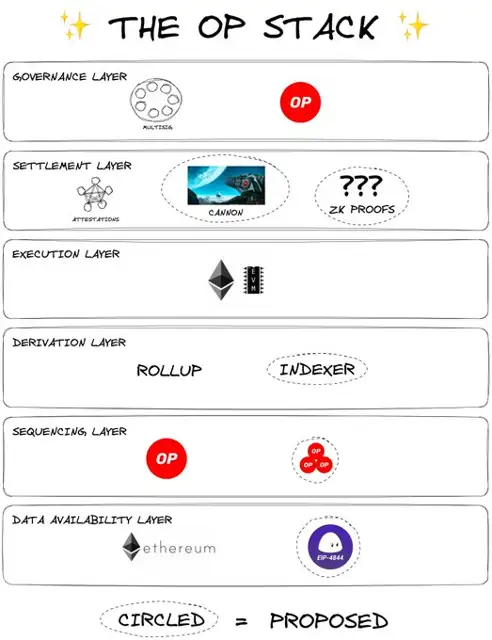
At its core, the OP Stack comprises software modules that define specific layers of the Optimism ecosystem. While its current primary function is facilitating L2 blockchains, its potential extends to higher layers, encompassing tools like block explorers, message communication protocols, governance frameworks, and more. The intention behind the OP Stack is to establish it as a public good, benefiting both the Ethereum and Optimism ecosystems.
The Optimism Bedrock serves as the current version of the OP Stack. It delivers tools essential for launching an industrial-grade Optimistic Rollup blockchain. But let’s explore that in more detail.
Optimism Bedrock: Features and Enhancements
Bedrock represents a quantum leap over its predecessor by offering:
🔴 Reduced Transaction Costs: Transaction fees are drastically lowered by optimizing data compression and employing Ethereum for data availability. Preliminary metrics indicate that this reduces fees significantly. Additionally, the elimination of EVM execution-related gas costs during L1 data submissions further lowers fees by roughly 10%.
🔴 Fast Deposit Times: Bedrock’s node software now supports L1 re-orgs, thereby drastically reducing deposit wait times from a previous maximum of 10 minutes to an anticipated 3 minutes.
🔴 Modular Proof Systems: A critical enhancement in Bedrock is its ability to detach the proof system from the main stack, allowing rollups to utilize either fault or validity proofs (such as zk-SNARKs) to verify execution validity.
🔴 Superior Node Performance: Node software performance has seen a significant boost. Nodes can now execute several transactions within a single rollup block, a departure from the previous "one transaction per block" protocol. In conjunction with improved data compression, this efficiency means state growth is cut down by an estimated 15GB annually.
🔴 Greater Ethereum Compatibility: Bedrock's design is closely aligned with Ethereum. This approach means several deviations present in the older versions have been rectified, including the one-transaction-per-block model, unique opcodes for accessing L1 block data, separate fee structures for L1/L2 in the JSON-RPC API, and custom representations of ETH balances.
Strategic Direction and Vision for the Superchain
The current OP Stack iteration (Bedrock) is crafted to support the upcoming Optimism Superchain, which is visualized as an interconnected network of L2s that share security protocols, communication frameworks, and a common development platform, i.e., the OP Stack itself. The central idea behind the Superchain is to have a network of standardized L2 chains, dubbed as OP Chains, which function one logical network. This system empowers developers to craft applications targeting the Superchain, thereby bypassing the intricacies of all the individual underlying chains.
How is Bedrock built to Support the Superchain?
🔴 SystemConfig Contract: This new introduction aims to directly define the L2 chain with L1 smart contracts. The objective is to encapsulate all details defining the L2 chain, including the creation of unique chain IDs, setting block gas limits, etc.
🔴 Sequencer Flexibility: A distinctive feature in Bedrock is the capacity to designate sequencer addresses via the SystemConfig contract. This innovation introduces the concept of modular sequencing, allowing various chains with unique SystemConfig contracts to have their sequencer address determined by the deployer.
🔴 DA Flexibility: Bedrock also provides flexibility with regards to Data Availability (DA). This flexibility allows builders to opt for optimized DA solutions, significantly reducing cost compared to DA on Ethereum L1.
🔴 Multi-Proof System Support: Bedrock will adopt Cannon as its primary fault-proof mechanism. Yet, it remains flexible, hinting at future integration with various optimistic as well as validity proof based systems in the future. This multiplicity in proof systems ensures a broader spectrum of security and optimization options, enhancing the resilience and adaptability of the network.
The Challanges on the Road to the Superchain
The anticipated success of the post-Bedrock Superchain release is expected to resemble a quantum leap on the scalability and decentralization journey of Optimism. Nevertheless, it's important to note that some challenges persist in achieving a fully scalable blockchain ecosystem.
⚠️ Challenges and Solutions with Withdrawal Claims:
Withdrawal claims currently necessitate reliance on a trusted set of chain attestors. There exists a potential solution to this challenge: by replacing the trusted attestors with permissionless proofs, such as Cannon, that offer entirely onchain dispute resolution. However, solely onchain proofs come with inherent risks, especially in the absence of a fallback mechanism. An innovative approach to circumvent this vulnerability is the integration of a multi-proof system, which offers redundancy, thus ensuring an enhanced safety net.
⚠️ Cross-Chain Transactions and the Challenge Period Hurdle:
The predominant drawback with fault proofs in cross-chain transactions is the necessary waiting period, known as the challenge period, before finalizing transactions safely. This waiting duration can vary, thereby affecting the speed at which assets are transferred between OP Chains. On the contrary, validity proofs present a solution to this latency issue. They eliminate the challenge period, paving the way for instantaneous asset transfers. However, validity proofs predominantly employ zero-knowledge proofs (ZKPs), which are not only expensive but also prone to bugs. Productionizing ZKPs, to the point they become the primary solution for cross-chain communication might still be a long journey. Nevertheless, the OP Stack’s modular proof system, which allows for simultaneous utilization of two proof systems, might support some interesting intermediate solutions. This dual system allows for both low latency bridging with compromised security and high-security bridging with increased latency.
Consequently, developers have multiple bridging options, including:
🔴 High-security, high-latency fault proof.
🔴 Low-security, low-latency fault proof.
🔴 Low-security, low-latency validity proof.
🔴 High-security, low-latency validity proof, upon the productionization of ZKPs.
⚠️ Addressing Asynchronous Cross-Chain Transactions:
A salient concern is the asynchronous nature of cross-chain transactions, which breaks atomic cross-chain composability. However, there's potential in introducing synchronous cross-chain messaging through a shared sequencing protocol across OP Chains. In this model, sequencers across chains reach a consensus regarding transaction inclusion, ensuring atomicity. Moreover, transaction fees are paid only upon successful inclusion on both chains, shifting the synchronization risk from users to sequencers. Implementing this shared sequencing protocol is feasible atop the modular sequencing layer of the post-Bedrock Superchain.
⚠️ Scalability Concerns with Posting Transactions to the Superchain:
A notable challenge is the non-scalable nature of posting transactions to the Superchain due to the limited data capacity of L1. An innovative solution could be a Plasma protocol, which can expand data availability for OP Chains. This protocol enables alternative Data Availability (DA) providers (Celestia and co.) to augment the restricted L1 DA.
Ecosystem Growth
The attractiveness of the OP Stack is evident from the rapidly expanding ecosystem of rollups being developed on top of it. Some notable examples include:
🔴 @BuildOnBase (Coinbase’s general purpose L2)
🔴 @0xMantle (BitDAO’s gneral purpose L2, using EigenDA)
🔴 @MantaNetwork (Universal zk circuits, using Celestia for DA)
🔴 @OPBNB_Network (General purpose L2 settling on BNB Chain)
🔴 @SynapseProtocol Chain (Cross-chain interop / bridging)
🔴 @ourZORA (NFT-centric)
🔴 @UniDexFinance (Spot & Perp DEX/Aggregator)
🔴 @DeBankDeFi (Social networking/portfolio tracker)
🔴 @OPCraft (Gaming)
🔴 @aevoxyz (Derivatives)
Conclusion
In conclusion, the OP Stack and the Superchain vision that comes with it, could be a game changer on the path towards a true multi-chain future. While challenges persist, Optimism offers a promising solution that could take us towards greater scalability and decentralization. If it keeps gaining traction quickly, we might see the OP Stack cement its strong position through the network effects inherent to the Superchain’s interop/composability-focused concept. 🔴✨
3 more images on X
How the covered assets moved · since 25 Sep 2023
Prices as of 23 Oct 2026This explainer walks through how things work without making a call on the token, so price moves since publication are shown as market context.
Covered in this piece
Since then
Zero has written 12 more pieces on Optimism and $OP since this one.
- Optimism Superchain explained: OP Stack, shared sequencing and RaaSBullish call on $OP
- Optimism Superchain thesis: OP Stack and the Stack WarsCovers $OP
- Superchain and OP Stack ecosystem summary with linked explainersOn Optimism
- OP Superchain plus RaaS: why app-specific rollups will launch on the OP StackOn Optimism
Daily closes in USD from DefiLlama and Yahoo Finance. Only a bullish or bearish thesis is read as a call; explainers, maps and mentions are context. Not financial advice.