
Intent-centric landscape map: infrastructure, solvers, apps and wallets
Quote1,369 words
Landscape of intent-centric projects compared across expression, solver candidates, solving process, selection and settlement, from CoW Swap and UniswapX to Essential, SUAVE and Anoma, grouped into infrastructure, supporting facilities, enterprise and consumer apps.
Key claims
1inch Fusion solvers are permissioned with KYC, CoW Swap uses bonding or DAO whitelisting
CoW Swap uses batch auctions, 1inch Fusion and UniswapX use Dutch auctions
SUAVE Centaur set to launch in 2023 Q4
Wen intents? 🤖 ✨
Now! The intent-centric ecosystem is growing quickly! 🚀
Don’t fade this new narrative and position yourself accordingly! 👀
To help you find your way around the ecosystem, I present to you the most comprehensive Intent-centric landscape overview you’ll find on X! 👇
⚠️ This list may or may not contain 100x opportunities. Pay attention!
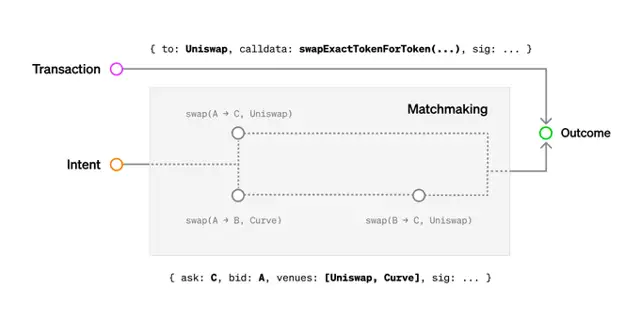
A clear narrative is emerging around the idea that intent-driven interactions are becoming the foundation of a user-friendly web3 experience. Instead of focusing on how the outcome is achieved, users simply need to express what they want, emphasizing the desired outcome rather than the path taken to achieve it.
Users simply approve intents to release assets and tips after their desired outcome is achieved, similar to cash on delivery in online shopping.
In a world dominated by intents, users have the option to choose from various solvers, both off-chain and onchain, to achieve their desired result and receive bonuses. This competition among solvers leads to increased efficiency and effectiveness.
In summary, users have the ability to clearly and directly express their intentions, while platforms can utilize solvers and executors to determine the best way to achieve user goals. Similar to web2, where optimization occurs behind the scenes, web3 executors can employ algorithms and automated processes to handle the complexities of execution, ensuring efficient delivery of desired outcomes and proper compensation for users.
By prioritizing user experience and emphasizing expressive intent, web3 has the potential to make decentralized systems accessible to everyone. The future of web3 lies in democratizing access, streamlining interactions, and providing seamless user experiences that guide users through the decentralized landscape, simplifying the complexities of execution.
I have covered the concept of intents in-depth here! 👇
🔗 twitter.com/zerokn0wledge_/status/1724441537453371804
I also explored the powerful confluence of AA and Intents as a disruptive force that will reshape web3 UX in detail here! 👇
🔗 twitter.com/zerokn0wledge_/status/1724698841054908463
⚙️ Different Types of Intent Implementations
Various types of intents can exist based on their generalization, as shown below.
In fact, there are different levels of intents present everywhere in the context of blockchain codes. These codes act as a form of automation, reducing complexity and providing users with the desired outcome.
However, in order to achieve greater functionality across different domains and improve scalability, it is important to focus on the most general intent in the future. AA + intent-specific apps are not sufficient, as they lack cross-domain functionality and do not scale as effectively as intents with a more permissionless nature. We need intent-specific infrastructure as well!
So, to better understand how intents works, let's examine the currently available solutions, starting from intent-specific apps to general intent infrastructure like Anoma and SUAVE.
The analysis can be divided into 5 main parts, each with different questions to consider:
▶️ Intent Expression and Authorization: How do users input their intents? What types and levels of intents can users express? What authorization do users grant?
▶️ Solver Candidates: Is it permissioned or permissionless? Are there high barriers to becoming a solver? Are there different types of solvers that focus on specific areas?
▶️ Solving Process: What is the main path to solving the solution? What determines the completion of the intents?
▶️ Solver Selection: What is the rule for selecting the winner from multiple solver candidates? Will the competition pattern be winner-takes-all or discrete?
▶️ Validation and Settlement: How is it verified whether the solver has completed the task? How is the settlement between users and solvers handled?
The assessment compares different intent-centric architectures, highlighting their unique features in intent expression, solver candidates, solving process, solver selection, and validation / settlement.
🤖 Cow Swap & 1inch Fusion (Limit Order Intent):
▶️ Traders express intents through platform interfaces, with off-chain message signing for authorization.
▶️ Solvers for 1inch Fusion are permissioned and undergo KYC, while Cow Swap uses a bonding pool or DAO criteria for whitelisting solvers.
▶️ Solvers identify the best trade execution considering various factors.
▶️ Cow Swap uses batch auctions for solver selection, while 1inch Fusion relies on Dutch auctions related to staked tokens.
▶️ Settlement involves ERC20 approvals, with validation ensuring adherence to the specified limit price and quantity.
Twitter: @CoWSwap & @1inch
🤖 UniswapX (Swap Intents):
▶️ Offers more freedom in setting parameters for Dutch auctions and allows cross-chain swaps.
▶️ Solver selection involves a Dutch auction mechanism, with prices decaying over time. RFQ can be used for initial price setting.
▶️ Cross-chain swaps require additional steps for validation and settlement.
Twitter: @Uniswap
🤖 Account Abstraction (Wallet-level Intent):
▶️ Users craft a userop through a 4337 wallet interface.
▶️ Bundler services are public goods, either wallet-specific or third-party infrastructures.
▶️ Bundlers simulate wallet operations offchain before submitting them onchain.
▶️ Solver selection is influenced by the success rate and reputation of bundlers.
▶️ The AA system validates and settles operations onchain, refunding ETH to the bundler.
Twitter: Multiple, see later in post.
🤖 Essential (Intent-Centric Account Abstraction Standard):
▶️ Uses a new constrained-based language for expressing intents, compatible with EVM chains.
▶️ Solver candidates include various types specialized for different intents.
▶️ Selection process resembles a Dutch auction based on constraints.
▶️ Validation and settlement occur through triggering specific onchain contracts.
Twitter: @intentessential
🤖 Flashbots SUAVE (Multi-domain Block-related Intent):
▶️ Involves expressing intents through EVM codes, bridging funds to SUAVE chain, and depositing tips.
▶️ Solver candidates include searchers and builders for block-related intents.
▶️ Solving process involves private off-chain computations and block building.
▶️ Solver selection prioritizes efficiency or uses an order flow auction mechanism.
▶️ Validation and settlement use oracles and SUAVE validators.
Twitter: n/a
🤖 Anoma (Generalized Intent for Anoma Protocols):
▶️ Users express intents by interacting with Anoma DApps.
▶️ Solver candidates monitor mempools and specialize in different applications.
▶️ Solvers run algorithms for matching intents and submitting transactions to mempools.
▶️ Selection is based on efficiency and promptness.
▶️ Validators use Anoma VM for execution and verification of intents.
Twitter: @anoma
More broadly, the ecosystem can be categorized into:
👉 Infrastructure
👉 Supporting Facilities
👉 Enterprise Applications
👉 Consumer Applications
🏗️ Infrastructure:
▶️ Flashbots SUAVE: Offers a modular plug-and-play alternative for decentralized and MEV-protected transaction ordering, maximizing revenue for validators and providing optimal execution for users. SUAVE Centaur is set to launch in 2023 Q4.
▶️ @anoma: A modular Dapp architecture deployable on various layers, enhancing versatility in EVM frameworks.
▶️ @axelarnetwork and @ComposableFin: Cross-chain intents.
▶️ @dappOS_com: The first intent-centric Web3 operation protocol, acting as a middleware for seamless interaction with crypto infrastructures. DappOS V2 version was recently released.
▶️ @CoWSwap: Builds settlement networks for transactions and released Cow Hooks for customizable DeFi operations.
🧱 Supporting Facilities:
▶️ ERC 4337: Improves wallet interaction by representing user intent, including payment options and transaction memory pool replacement.
▶️ Various tools and protocols support account abstraction and intent, like @Safe, @zerodev, @biconomy or @gelatonetwork.
For more on the benefits of account abstraction, have a look at my thread below! 👇
twitter.com/zerokn0wledge_/status/1642889752839077888
⚙️ Enterprise Applications:
Includes various APIs and tools like Solver API, Intent API, intent-based swap infrastructures (Bob the Solver by @BananaHQio, @BrinkTrade), and composable intent tools (@intentessential)
👤 Consumer Applications:
▶️ Smart Wallets: Includes @Safe, @Biconomy, @argentHQ, @myBraavos, @AmbireWallet and others.
▶️ DEX: Platforms like @CowSwap, @1inch Fusion, @Uniswap X and intent-based RFQ PerpDEXes like @Thena or @IntentX (stay tuned for a separate report on RFQ-based Perp DEXes).
▶️ Intelligent Frontends: Includes interfaces like @Unibot, @bananagun, @wiskerstrade or @Blacksmith0x today. In the future AI (text / voice promts) will become the UI.
This architecture aims to address challenges in intent-based implementation, with significant development in infrastructure and a trend toward intelligent consumer applications.
▶️ Smart Wallets: ERC-4337 introduces a UserOps layer for expressing user intent, driving the adoption of Smart Contract Wallets (SCW).
▶️ DEX Evolution: Intent-Based Trading in DEXs is enhancing capital efficiency and user experience, with innovations like CoW Hooks and Intent-Based RFQ.
▶️ Intelligent Frontends: Gateways are evolving to understand user intent, converting it into automated tasks, and making Web3 interactions smarter and more intuitive.
That's a wrap for today! I hope you enjoyed this deep dive! 🫡
Make sure to follow me @zerokn0wledge_ and stay tuned for more insights into the world of intents! ✨
QUOTING @zerokn0wledge_
0/ a key issue hindering blockchain adoption is user experience. The primary interface to web3 for the user is the wallet, so improving wallet UI/UX is essential 🏆 a GAME-CHANGER for wallet UX pioneered by @zksync & @StarkWareLtd is account abstraction WTF is it? 🤔 🧵 (0/27)
0/ a key issue hindering blockchain adoption is user experience. The primary interface to web3 for the user is the wallet, so improving wallet UI/UX is essential 🏆 a GAME-CHANGER for wallet UX pioneered by @zksync & @StarkWareLtd is account abstraction WTF is it? 🤔 🧵 (0/27)
3 more images on X