
Chain abstraction explained: types and the top 3 protocols
Thread1,139 words
Explains how modularity causes fragmentation and sorts chain abstraction into account, blockchain and application levels. Picks Particle, NEAR and Socket as the leaders, favoring account-level abstraction for UX.
Key claims
Top 3 are Particle Network, NEAR and Socket
Account-level abstraction most directly empowers users
Autonomous agents will dominate onchain activity
Chain Abstraction is not a specific protocol.
Chain abstraction is a set technologies, designed to unify UX in an increasingly fragmented Web3 landscape.
Why does it matter & which protocols should you be watching?
Find out. ↓
Today, we will look into:
➊ 𝖬𝗈𝖽𝗎𝗅𝖺𝗋𝗂𝗍𝗒 & 𝖥𝗋𝖺𝗀𝗆𝖾𝗇𝗍𝖺𝗍𝗂𝗈𝗇
➋ 𝖳𝗁𝖾 𝖳𝗒𝗉𝖾𝗌 𝗈𝖿 𝖢𝗁𝖺𝗂𝗇 𝖠𝖻𝗌𝗍𝗋𝖺𝖼𝗍𝗂𝗈𝗇
➌ 𝖳𝗁𝖾 𝖳𝗈𝗉 𝟥 𝖢𝗁𝖺𝗂𝗇 𝖠𝖻𝗌𝗍𝗋𝖺𝖼𝗍𝗂𝗈𝗇 𝖯𝗋𝗈𝗍𝗈𝖼𝗈𝗅𝗌
➍ 𝖢𝗈𝗇𝖼𝗅𝗎𝗌𝗂𝗈𝗇
Let's dive in. ↓
➊ 𝗠𝗼𝗱𝘂𝗹𝗮𝗿𝗶𝘁𝘆 & 𝗙𝗿𝗮𝗴𝗺𝗲𝗻𝘁𝗮𝘁𝗶𝗼𝗻
The modular thesis advocates for the separation of the functions of a decentralized network into distinct, interchangeable layers.
In these functional areas, specialized players arise, which provide specific network functions to modular execution layers (rollups) at scale.
Relying on these highly specialized infra service providers, applications can overcome the scalability bottlenecks that persist in monolithic, general-purpose blockchains, and can scale much more efficiently.
Additionally, increasingly mature tooling around this infrastructure, significantly abstract complexity in building (potentially app-specific) execution layers.
More specifically, this includes rollup stacks like:
- @Optimism's OP Stack
- @arbitrum Orbit
- @0xPolygon CDK
- @initia Interwoven Stack
- more
And Rollup-as-a-Service frameworks (which allow anyone to deploy modular rollups in a few clicks) such as:
- @Calderaxyz
- @conduitxyz
- @alt_layer
- @gelatonetwork
- more
In other words, the modular thesis reduces the barriers of entry for building decentralized networks and gives rise to the infra & tooling devs need to build fully customized, highly scalable blockchains from scratch with ease.
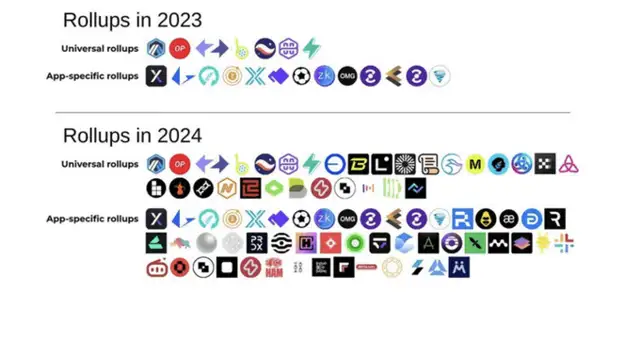
This significantly accelerates appchain season and rapidly moves us towards a multichain future composed of thousands of app- and vertical-specific chains (incl. many altVMs).
Sounds amazing, right?
So, what's the problem?
That's not growth, it's fragmentation bro.
While laying the technical groundwork for mass adoption, modularity or more specifically the emergence of all these execution layers, also leads to users and liquidity being scattered across different chains.
Fragmentation adversely impacts UX, introducing friction between ecosystems, ultimately making it more complex to move liquidity around or interact with applications throughout the Web3 ecosystem.
10 different chains, 10 different wallets, 10 different bridges, crypto UX today is far away from mass adoption and beyond our bubble,
Chain Abstraction solves this.
So, how does it work and who exactly is fixing this? ↓
➋ 𝗧𝗵𝗲 𝗧𝘆𝗽𝗲𝘀 𝗼𝗳 𝗖𝗵𝗮𝗶𝗻 𝗔𝗯𝘀𝘁𝗿𝗮𝗰𝘁𝗶𝗼𝗻
There are dozens of protocols, across various sub-sectors, building towards a chain abstracted future.
@therollupco has created a great landscape overview that also impressively shows the diversity within the Chain Abstraction vertical.
Since the goal of this post is to identify the current leaders, I will keep this part brief and use a slightly less granular approach to categorize the Chain Abstraction solutions in the market.
Let's dive in. ↓
➤ Account-level Chain Abstraction
Account-level chain abstraction allows users to operate across multiple blockchains with a single, unified account, where a consolidated balance is accessible across the ecosystem.
This removes the need for users to manage separate balances or understand which chains they're interacting with.
Instead, the complexity of multiple chains is seamlessly handled at the account level, creating a simplified, chain-agnostic experience for end-users.
Who is building this?
- @ParticleNtwrk
- @NEARProtocol
- @OneBalance_io
- more
➤ Blockchain-level Chain Abstraction
Blockchain-level chain abstraction unifies the underlying infrastructure and architecture across multiple blockchains, creating a cohesive network of shared security, bridging, communication, and liquidity.
This foundational layer streamlines interoperability, enabling more efficient development and operation of higher-level applications across interconnected chains.
Who is building this?
- @AvailProject Nexus
- @0xPolygon Agglayer
- @Optimism Superchain
- more
➤ Application-level Chain Abstraction
Application-level chain abstraction equips developers with tools to seamlessly manage assets, data operations, and user balances across multiple chains, typically through SDKs or APIs.
This developer-centric approach allows applications to deliver a chain-agnostic experience, enabling users to interact effortlessly across the ecosystem while enjoying a user experience as smooth as if everything operated on a single chain.
Who is building this?
- @agoric
- @SocketProtocol
- @SkipProtocol
- more
➌ 𝗧𝗵𝗲 𝗧𝗼𝗽 𝟯 𝗖𝗵𝗮𝗶𝗻 𝗔𝗯𝘀𝘁𝗿𝗮𝗰𝘁𝗶𝗼𝗻 𝗣𝗿𝗼𝘁𝗼𝗰𝗼𝗹𝘀
So, with so many different technologies and players in the Chain Abstraction vertical, who is leading REALLY leading this crucial narrative?
Let me introduce you to my current Top 3:
✪ @ParticleNtwrk
Account-level chain abstraction solution that enables users to use a single account across any supported chain, while maintaining one universal balance, and being able to use any token for gas.
The Particle team has been shipping exceptionally hard. Early access to the universal account demo is live, and I got to try it.
That's basically already I need to say here, but can't omit the fact that Particle is among the solutions with the broadest chain support (also not limited to any ecosystem or cluster of chains), which is absolutely key.
Particle is spearheading the Chain Abstraction Coalition, with dozens of major blockchain ecosystems among its partners.
It is also worth flagging that Particle is among the mindshare dominators, constantly present in conversations around Chain Abstraction and coining the narrative actively with research, education and thought leadership.
Finally, I generally think that this account-level abstraction is the approach that most directly empowers the user, significantly improving UX (one wallet, any chain) and entirely abstracting native gas tokens and bridging.
✪ @NEARProtocol
NEAR is the only L1 that natively integrates chain abstraction, allowing NEAR accounts to sign transactions across any chain using a concept called "chain signatures".
It has a huge user base and an ecosystem that stretches from DeFi to consumer apps. Near is generally strong on UX, and with the broad chain support, which includes Bitcoin, Ethereum, Solana and others. Definitely among the protocols that are most advanced in making the vision of a chain abstracted UX a reality.
NEAR's strong focus on (user-owned) AI is another interesting feature. I believe that in the future, autonomous agents will dominate on-chain activity. Controlling Near accounts, they can do so across any chain.
Additionally, and as a well established player in the crypto space, NEAR also has comparably high mindshare and a big ecosystems of builders that can build or integrate with its chain abstraction tech seamlessly.
✪ @SocketProtocol
Socket is built on an application-centric design, and leverages Modular Order Flow Auctions (MOFA) to allow builders to compose apps, users and assets across any chain. Socket is also building Magic Accounts, which similar to Particle's universal accounts, allow users to have a unified balance (across chains in the Ethereum ecosystem only though).
Socket is also a true pioneer of the Chain Abstraction narrative and well established within the Ethereum ecosystem. @BungeeExchange is the flagship application on top of Socket and a global liquidity marketplace, bringing deep liquidity for any asset to any chain in the ecosystem.
➍ 𝗖𝗼𝗻𝗰𝗹𝘂𝘀𝗶𝗼𝗻
Chain Abstraction is inevitable.
DYOR anon.
Also: Chain Abstraction landscape overview dropping soon, stay tuned. 👀
Want to see how the @ParticleNtwrk Universal Accounts look like?
Check my post on the demo here! ↓
x.com/zerokn0wledge_/status/1836874909152395465
3 more images on X
What came next · since 29 Oct 2024
Show how the covered asset moved
This explainer walks through how things work without making a call on the token, so price moves since publication are shown as market context.
Covered, no call
Since then
Zero has written 21 more pieces on NEAR Protocol and $NEAR since this one.
- Quantum and post-quantum map: PQ crypto assets by readinessOn NEAR
- I Built a Research Desk Staffed Entirely by AI Agents. It Works.Covers $NEAR
- New vs returning wallets across Ethereum, Solana, NEAR, Polygon and SuiCovers $NEAR
- NEAR DCML explained: confidential, verifiable and monetizable AI via TEEsCovers $NEAR
Daily closes in USD from DefiLlama and Yahoo Finance. Only a bullish or bearish call in a thesis or market take is tracked; explainers, lists, maps and mentions are neutral context. Not financial advice.