
Bittensor explained: subnets, Yuma Consensus and the leading subnets
Post503 words
Long explainer on Bittensor as a decentralized marketplace for digital commodities: miners and validators compete in subnets, Yuma Consensus distributes TAO emissions, and the post lists leading subnets across compute, training, inference and prediction.
Key claims
AI is a $757.6B market in 2025, projected at $3.68T by 2034
Validators produce weight vectors feeding Yuma Consensus, which distributes TAO emissions
More than 100 subnets exist
AI is already a $757.6 billion market in 2025 and is projected to grow to $3.68 trillion by 2034.
As we stand on the brink of the AI age, the infrastructure underpinning this future becomes increasingly critical.
Dominated by centralized AI giants like OpenAI, Google, Meta or Anthropic, the market is now witnessing the rise of a game-changing technology that will challenge the status quo.
Meet Bittensor, the decentralized backbone of open-source AI.
Termed by some as the "hunger games of crypto AI," Bittensor could significantly accelerate the disruption of the AI sector by open-source tech, through its introduction of an open, decentralized marketplace for digital commodities (many essential for AI).
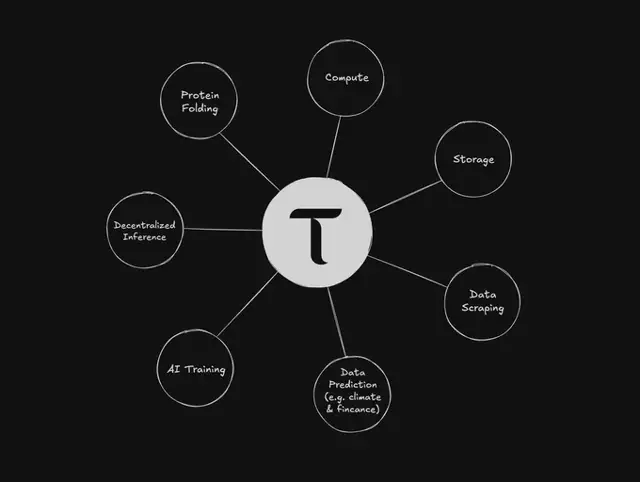
These digital commodities include computational power, data storage, AI inference & training, protein folding, financial prediction, and more. All in one diverse ecosystem, under one unified token system, and powered by onchain coordination.
So let's have a look at how this works.
At the heart of Bittensor lies a unique network architecture and a competitive ecosystem of participants. More specifically:
→ Miners provide digital commodities using their models and datasets, competing within task-specific marketplaces known as subnets.
→ Validators rigorously assess miner outputs, ensuring only the highest-performing models thrive and evolve.
This natural-selection mechanism rewards top models, continuously encouraging AI quality and performance through incentives.
→ Subnets: Each subnet operates as a decentralized, competitive marketplace producing specific digital commodities. Miners produce, validators assess and rank miner output. One example for instance is the text prompting subnet managed by @opentensor, which rewards miners based on prompt-completion quality.
→ Bittensor Blockchain: The decentralized ledger recording activities, incentives, and transactions. $TAO (τ), the native token, drives participation and competition, incentivizing continual optimization of subnet performance.
→ Bittensor SDK/API: Facilitates interactions between miners and validators, streamlining participation, and ensuring a seamless Bittensor blockchain integration.
Validators periodically produce weight vectors, ranking miners based on their performance. These rankings feed into the blockchain, forming a weight matrix. Using the Yuma Consensus mechanism, the blockchain calculates and distributes $TAO emissions based on subnet rankings and staked participation.
What is being built on Bittensor?
Will cover this in more depth separately (there are >100 subnets), but lets have a quick look at some of the leading ones you should know:
- @chutes_ai (Serverless AI Compute)
- @gradients_ai (AutoML / AI Model Training)
- @nineteen_ai (Open-source AI Inference)
- @tplr_ai (Incentivized Internet-wide Training)
- @SturdyFinance (Decentralized Yield Optimization)
- @ComputeHorde (Compute for Subnet Validators)
- @omron_ai (Verifiable AI Inference)
- @CM_Precog (Data-driven Crypto Price Predictions)
- @flock_off_sn96 (FLock Open Federated Framework for SLM Training)
- Synth by @modenetwork (Data-driven Crypto Price Predictions)
- OpenKaito by @latentholdings (Text Embedding Models)
- @metanova_labs (AI drug discovery)
- @celiumcompute (Decentralized Compute Marketplace)
- @webuildscore (Computer Vision)
- many more
NFA but DYOR anon.
Make sure to drop a follow @zerokn0wledge_ if you want to learn more about Bittensor, and stay up to date with its subnet ecosystem. Will soon cover more key topics, incl. dTAO and alpha tokens, $TAO tokenomics, in-depth subnet coverage, etc.
2 more images on X
How the covered assets moved · since 22 May 2025
Prices as of 23 Oct 2026This explainer walks through how things work without making a call on the token, so price moves since publication are shown as market context.
Covered in this piece
Since then
Zero has written 10 more pieces on Bittensor and $TAO since this one.
- Watchlist additions: TAO, PURR, EDEL and BPOn Bittensor
- I Built a Research Desk Staffed Entirely by AI Agents. It Works.Covers $TAO
- AI infra projects on watch: Bittensor, Sentient, NEAR, Ritual and moreOn Bittensor
- Why DeAI matters across the AI stack: seven layers from incentives to computeOn Bittensor
Daily closes in USD from DefiLlama and Yahoo Finance. Only a bullish or bearish thesis is read as a call; explainers, maps and mentions are context. Not financial advice.