
OpenLedger deep dive: Datanets, Proof of Attribution, OpenLoRA and ModelFactory
Thread455 words39 likes
OpenLedger is an OP Stack L2 where dataset uploads, training and rewards occur onchain, with Proof of Attribution linking data to outputs. OpenLoRA serves thousands of fine-tuned models on one GPU and ModelFactory offers no-code fine-tuning across nine LLM families.
Key claims
OpenLoRA needs 8-12GB vs 40-50GB memory and 20-50ms latency vs 100-300ms
3.7x faster training vs P-Tuning
Testnet: almost 26M txs, >22k contracts, ~1.3M wallets
I'm sure that AI infra will be among the big runner narratives when altseason hits.
Among the high potential plays that I'm monitoring in this sector, one that stands out to me, is @OpenledgerHQ.
Let me explain why ↓
➤ OpenLedger is an AI-native infra layer targeting the specialized AI model economy, countering the general-purpose LLM dominance, and aiming to usher in a new era of domain-specific, fine-tuned models (customized versions trained on specific datasets) that require the targeted datasets OpenLedger offers.
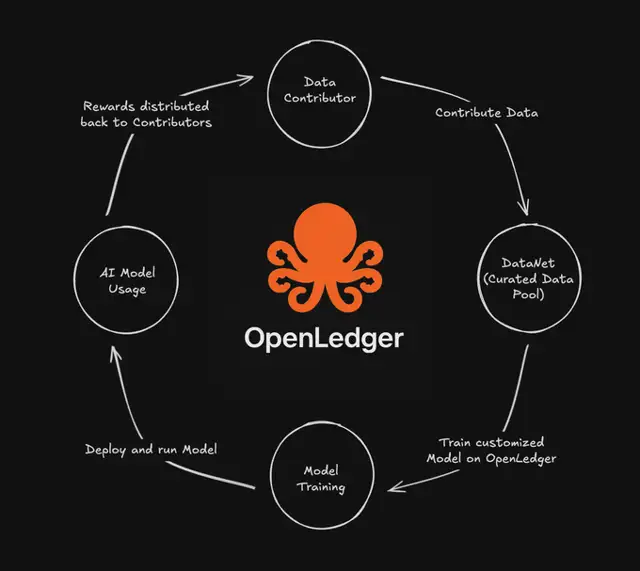
➤ All AI operations execute onchain (on OpenLedger's OP stack-based Ethereum L2) including dataset uploads, model training, reward distribution and governance, creating transparent attribution from data contribution through inference monetization.
➤ Datanets on OpenLedger aggregate community-owned, domain-specific datasets, addressing the need of specialized models for specialized data, and based on the thesis that general-purpose models like ChatGPT cannot efficiently serve for niche use cases.
➤ Proof of Attribution cryptographically links individual data contributions to model outputs, enabling granular reward distribution that transforms every inference into monetizable events for data providers.
➤ Attribution pipeline measures feature-level influence and contributor reputation for transparent reward calculation, addressing the black box problem where AI training contributions remain untrackable.
➤ Stake slashing penalizes malicious data contributions (financial penalties for bad actors) while reputation scoring creates self-regulating quality mechanisms, incentivizing high-fidelity, domain-specific datasets.
➤ OpenLedger's OpenLoRA achieves 4x memory efficiency (8-12GB vs 40-50GB) serving thousands of fine-tuned models on single GPU with <100ms switching and 2000+ tokens/sec throughput, solving the cost barrier for personalized AI.
➤ 3.7x faster training versus P-Tuning (existing fine-tuning method) with superior Rouge scores while 4-bit quantization (compression technique) maintains accuracy, solving the scaling bottleneck for personalized AI deployment.
➤ Flash-attention and SGMV optimizations (memory and computation efficiency techniques) deliver 20-50ms latency versus 100-300ms traditional serving, critical performance threshold for real-time AI apps.
➤ Dynamic adapter loading enables just-in-time LoRA merging (combining model modifications on-demand) without preloading requirements, supporting ensemble inference across specialized models without memory bottlenecks.
➤ The ModelFactory on OpenLedger eliminates technical barriers of entry with GUI-only fine-tuning across 9 LLM families (incl. LLaMA, Mistral, DeepSeek) while maintaining dataset access controls, democratizing AI model customization by removing the need for coding skills.
➤ Its OP Stack rollup on Ethereum uses $OPEN token (also used for governance) as native gas with canonical bridge architecture, inheriting Ethereum security without validator staking (but paying the L1 for settlement and DA).
➤ OpenLedger has a live testnet, where it has achieved some very strong stats: almost 26M transactions, >22k smart contracts and roughly 1.3M active wallets.
Given there is a @KaitoAI leaderboard with significant $OPEN rewards, I highly recommend to DYOR and start yapping.
@OpenledgerHQ Adding context on $OPEN rewards for yappers in case you're wondering.
x.com/zerokn0wledge_/status/1934942467284963414
3 more images on X