
Loyal AI: Sentient's OML framework and model fingerprinting explained
Quote752 words17 likes
Explains Sentient's OML (Open-access, Monetizable, Loyal) framework: models fingerprinted with secret trigger phrases, permission tokens per use, and onchain staking and slashing for fraud. Perinucleus Sampling avoids catastrophic forgetting.
Key claims
Loyalty = Ownership + Alignment + Control
Fingerprint violations trigger slashing of developer collateral
Adaptive fingerprinting defends against coalition attacks
𝗟𝗼𝘆𝗮𝗹 𝗔𝗜: 𝗔 𝗣𝗿𝗮𝗰𝘁𝗶𝗰𝗮𝗹 𝗕𝗹𝘂𝗲𝗽𝗿𝗶𝗻𝘁 𝗳𝗼𝗿 𝗠𝗼𝗻𝗲𝘁𝗶𝘇𝗶𝗻𝗴 𝗢𝗽𝗲𝗻-𝗦𝗼𝘂𝗿𝗰𝗲 𝗠𝗼𝗱𝗲𝗹𝘀
The AI world has been stuck between two bad options: truly open-source models that creators can't monetize or control, and closed, black-box APIs that lock everyone into a corporate ecosystem.
This has been the single biggest obstacle to a thriving, decentralized AI landscape.
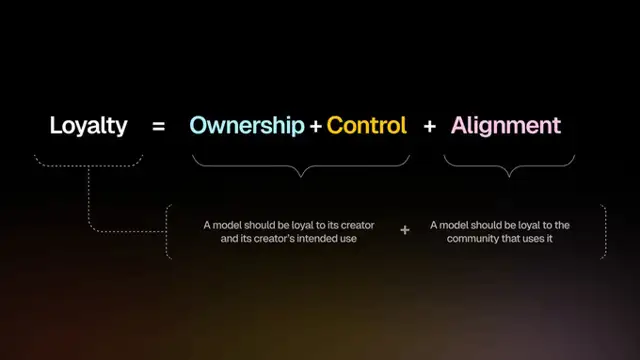
Luckily, @SentientAGI's vision for "Loyal AI" is designed to break this stalemate, built on a simple but powerful equation:
Loyalty = Ownership + Alignment + Control.
This has given rise to the OML framework, which provides a complete blueprint for creating AI that is both open and economically self-sustaining, with a primary focus on solving the foundational pillar of Ownership.
1 ) The OML Framework: The Rulebook for Ownership
To turn the Loyal AI vision into a reality, Sentient created the OML (Open-access, Monetizable, Loyal) protocol. Think of OML as the formal rulebook that any system must follow to guarantee creator ownership.
An OML-compliant model has three key properties:
➤ Open-access: The model is available for anyone to download and run locally. Think of it like a video game that you can run on your own machine, where you have the executable file, but not the source code. It's yours to use privately and efficiently, but the core mechanics are protected.
➤ Monetizable: The model is engineered to require permission for each use. This allows creators to set terms and capture value, enabling fine-grained, pay-per-use business models even for a locally-run model.
➤ Loyal: This is the most crucial part. The model is designed to only work correctly with a valid permission token. Without it, it doesn't just crash, it's engineered to produce a useless or incorrect output, making unauthorized use pointless.
2 ) The Technology: OML 1.0 and Scalable Model Fingerprinting
OML 1.0 is the first practical implementation of this framework, built on a clever system of crypto-economic incentives and a core technology called Model Fingerprinting. It's an "optimistic" system where cheating isn't impossible, but it is verifiably and prohibitively expensive.
2.1 ) What is Fingerprinting?
Think of it as embedding thousands of invisible watermarks directly into the neural network's parameters. This is done by fine-tuning the model on a set of secret "trigger phrases" (keys) that force it to produce a specific, unique "signature" (response).
The main challenge is doing this at scale without causing "catastrophic forgetting", degrading the model's general intelligence. To achieve this, Sentient’s research uses a technique called Perinucleus Sampling, which finds a sweet spot for generating signatures.
Instead of using obvious, out-of-distribution responses (which are easy to detect) or overly natural ones (which aren't unique), it picks responses that are plausible but statistically unlikely, making them both stealthy and robust identifiers.
2.2 ) The Crypto-Economic Workflow
OML 1.0 operationalizes this technology with a game-theoretic, onchain protocol:
A developer wanting to use a model first stakes collateral in a smart contract to receive a uniquely fingerprinted copy. When serving the model, the developer is required to get a permission token for each query, creating an onchain record of paid usage.
Community "provers" can audit the developer's service at any time by sending a secret trigger phrase. If the service returns the correct signature without a corresponding payment record on-chain, it creates undeniable proof of fraud.
This proof automatically triggers the smart contract to slash the developer's collateral, making non-compliance a losing game.
2.3 ) Robustness Against Advanced Threats
The OML 1.0 system is designed to be secure even against a sophisticated white-box adversary who has full access to the model's weights.
The formal security goals are:
➤ Model Extraction Resistance (preventing the creation of a permission-less clone)
➤ Permission Forgery Resistance (preventing the creation of fake permissions).
Crucially, Sentient's research also anticipates and defends against advanced threats like coalition attacks, where an adversary merges multiple fingerprinted models to wash out the watermarks.
Drawing from the mathematical field of "search with liars," Sentient has developed adaptive fingerprinting schemes that can provably identify malicious actors even within such a coalition, ensuring the system's security and long-term viability.
What's the conclusion?
This integrated stack represents the first comprehensive and viable blueprint for solving the open-source ownership problem.
The Loyal AI vision provides the "why," the OML framework provides the "what," and Model Fingerprinting provides the practical, battle-tested "how."
In its entirety, it's a complete solution for a sustainable, community-driven AI economy where creators can finally build in the open without sacrificing control or commercial viability.
If you want to dive deeper, check the OML whitepaper yourself here:
arxiv.org/pdf/2411.03887
QUOTING @zerokn0wledge_
𝗚𝗥𝗜𝗗: 𝗔 𝗧𝗲𝗰𝗵𝗻𝗶𝗰𝗮𝗹 𝗮𝗻𝗱 𝗘𝗰𝗼𝗻𝗼𝗺𝗶𝗰 𝗕𝗹𝘂𝗲𝗽𝗿𝗶𝗻𝘁 𝗳𝗼𝗿 𝗗𝗲𝗰𝗲𝗻𝘁𝗿𝗮𝗹𝗶𝘇𝗲𝗱 𝗔𝗚𝗜 AGI, a.k.a. artificial intelligence that can match or exceed human performance across all cognitive tasks, represents the most transformative technology in human history. It is poised to automate virtually all knowl
𝗚𝗥𝗜𝗗: 𝗔 𝗧𝗲𝗰𝗵𝗻𝗶𝗰𝗮𝗹 𝗮𝗻𝗱 𝗘𝗰𝗼𝗻𝗼𝗺𝗶𝗰 𝗕𝗹𝘂𝗲𝗽𝗿𝗶𝗻𝘁 𝗳𝗼𝗿 𝗗𝗲𝗰𝗲𝗻𝘁𝗿𝗮𝗹𝗶𝘇𝗲𝗱 𝗔𝗚𝗜 AGI, a.k.a. artificial intelligence that can match or exceed human performance across all cognitive tasks, represents the most transformative technology in human history. It is poised to automate virtually all knowl
3 more images on X