
Robotics szn: three bets via Unitree perp, BOT closed-end fund and CODEC
Quote1,173 words33 likes
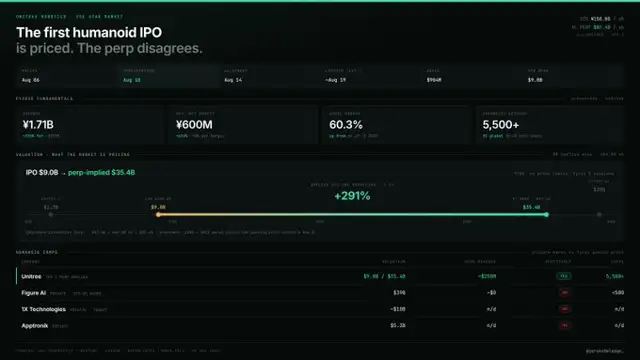
Lays out three ways to play the Unitree IPO: the HIP-3 perp as the ignition bet, BOT (a closed-end fund at about 2.9x NAV) as equity beta, and CODEC as the crypto play. Notes the IPO prices Unitree at 219x earnings and the perp implied about $35B.
Key claims
BOT NAV was $10.51 on June 30 vs about $30 price (2.9x)
BOT holds Standard Bots 35% and Figure only 15%
Perp implied about $35B vs Figure AI's $39B
We’re about to see a generational bullrun.
The vertical?
Robotics.
The rationale behind my three main bets:
1 ) The Ignition Bet
With $UNITREE IPO 5,526x oversubscribed, and almost 10m orders submitted from individual investors, the retail hype is undeniable. On Hyperliquid’s HIP-3 markets, which are the prime venue for pre-IPO price discovery and hence the best IPO oracle expectations are clear too. At $87 (vs. ~$22 IPO price), the market expects this thing to rip upwards on listing day. Wrote about this in more detail here: t.co/8Y1xzSCnNd.
Since I started scaling in at $80, I’ve added quite significantly the past two days, to be ready for the listing early next week. Not sure what the ceiling will be, but the Shanghai Stock Exchange’s STAR board (basically Chinese Nasdaq), doesn’t have a price cap during the first 5 days. Looking at subscription metrics and considering that this is the first major robotics pure play to go public, this could be an explosive opening. But it's also worth noting still that the IPO values Unitree at 219x 2025 earnings and 36x sales (which is already not too conservative), and no Western retail investor can legally buy 688836 directly. However, it is available to trade on HIP-3 markets by @tradexyz and @tradeparagon.
The valuation of around $35B USD currently implied on Hyperliquid puts Unitree roughly on par with its main US comp (Figure AI valued at $39B post-money in its last funding round in September 2025). But while that valuation makes sense as an initial reference number, we all know how fast innovation cycles and repricings in these tech verticals go. So imo fair to assume that this valuation is already stale, and even more so that Chinese retail won’t care about it when their bluechip robotics play goes live publicly.
I’m positioned.
2 ) The Equity Beta
Looking at other US robotics companies and their private market valuations, most still sit far below Figure and Unitree. Hyundai bought Softbank’s 10% stake on their Boston Dynamic’s exit at an implied valuation of $3.4B (predetermined put option price from a 2021 agreement tho), while Korean brokerages estimated valuations of up to $20B on the Atlas hype post-CES in March 2026, and Bloomberg coverage citing numbers of up to $100B. Meanwhile, Apptronik raised $520M from Google, Mercedes-Benz, B Capital and new investors, bringing the Series A to $935M total at a ~$5.3B post-money valuation in February 2026, and 1X (after a 2024 round at $820m valuation), has reportedly been seeking up to $1B at $10B+ in recent months. Smaller players like Standard Bots ($1B post-money in June 2026 series C) or Dyna (>$600m valuation $120m series A in September 2025) still sit significantly lower.
The problem is that getting access to these private market titles is almost impossible for most of us.
But wait, is it really?
There might be a loophole if you’re looking for broader exposure and it’s called $BOT (Robostrategy Inc.), which is a publicly listed (Nasdaq) company that isn’t actually an operating business. It’s a closed end fund holding equity in 14 private robotics and embodied AI companies, including the above-mentioned Figure AI, Apptronik, Standard Bots and Dyna, as well as Dexmate Path Robotics and others.
Yet, there is a catch, and it’s what you’re paying for the exposure. NAV (aka net asset value, which is determined on monthly basis by Roboadvisory) was $10.51/share on June 30th. The stock is trading around $30. That means you’re paying roughly 2.9x the value the fund assigns to its own book. Plus, the concentration around Standard Bots (35%) means that this is by no means a "Figure" proxy, with the latter only making up 15% of the fund (means a dollar in $BOT buys about 5 cents of Figure exposure.
Whether that makes sense or not, ultimately depends on you’re expectations for where this industry vertical and its valuations are heading. Unitree’s public SSE debut might be a first indicator.
For me personally, the bet makes sense, and there is a HIP-3 market by @tradexyz on Hyperliquid.
I’m positioned.
3 ) The Crypto Play
This is where it gets REALLY interesting for risk-seeking chads, bc imo there is one heavily undervalued play out there that is shipping real tech, innovating rapidly, and that has survived through one of the toughest years our industry has seen to date (see my post on the great shakeout here: t.co/hlYAtdXdNm), while building in public all along.
Meet @codecopenflow, aka the first team to build out the full stack to simulate, train, deploy and fund robots under one roof.
I won’t make this too extensive as it warrants its own separate writeup, but let me quickly go over the key points:
Robotics teams are still spending more time wiring tools together than building actual hardware/robots. They buy simulation capabilities from one vendor, compute from another, runtime from a third, and so on.
Meanwhile, robotics datasets on HuggingFace have 10x’d over the last year, but most teams lack the tooling to properly use them.
$CODEC fixes both.
Their “SimArena” (simulation tooling) allows anyone to literally just describe a scene, drop in a robot, and watch it move with options for subsequent export to MuJoCo or Isaac Sim when you're ready to scale. Basically vibe-coding for robotics.
This means all you need is one engineer, a browser, and a cheap arm (costs a few hundred dollars nowadays), and you can do what took a fully funded team just 1-2 years ago. Build the scene, collect demos, train a policy and watch it run.
That levels the playing field, allowing any student, indie builder, lab, or startup to start at the same entry point.
But the stack doesn’t end there:
Through their compute layer “Fabric", they also provide serverless GPU compute for simulation, training, and inference at an easily accessible and efficient pay per second cost model. Fabric routes btwn cloud and edge based on what the task needs, and how fast the robot needs to react.
Meanwhile “OPTR” is their runtime that connects the robots to the cloud. A vision-language-action (VLA) loop that runs on your chip, allowing the same operator to work on a desktop arm or a humanoid, and that can be plugged into existing ROS stacks.
With “The Foundry”, an accelerator built to get Physical AI / Robotics founders from a working prototype to a shipped product, they’ve recently entered the next stage of their journey, and @machinedotfun (built together with @peaq) could be the breakout moment. Expecting more infos to drop soon.
But back to the $CODEC play: At ~$3m FDV (lower circulating btw) and with a year of supply distribution after it’s community-centric launch on @pumpfun (no VC rounds etc), the token looks cheap.
While initial launch hype pushed it up to ~$35m, it has retraced >90% from the highs amid a tough market since then, but (unlike many others) the team is still here, is still shipping, and even accelerating, right as we head towards the first major robotics IPO in history.
I’m positioned.
You too anon?
QUOTING @zerokn0wledge_
How bad 2026 really is? - 120+ projects shut down - Over $1.3B stolen across 344 exploits - Crypto hiring down ~80% What happened? Three things at once, and only one of them was the market. First, the token treasury model finally got tested. Teams raised in tokens, paid salar
How bad 2026 really is? - 120+ projects shut down - Over $1.3B stolen across 344 exploits - Crypto hiring down ~80% What happened? Three things at once, and only one of them was the market. First, the token treasury model finally got tested. Teams raised in tokens, paid salar
3 more images on X