
Standard Reserve TL;DR: an onchain central bank that fixes Olympus design
Quote873 words
OHM hit >$4B in 2021 then fell 98%; Standard swaps fixed APY for issuance tied to net ETH flow through a v4 hook pool. Inflow buys tokenized gold, outflow buys and burns STANDARD; fees split 70% vault, 15% permanent liquidity, 15% team.
Key claims
1B hard cap with 100M locked in the pool at genesis
Licenses: 100 a day, max 3 per charter, 100% burned
Issuance decisions use the trailing two epochs
$OHM ran to >$4B mcap in 2021 selling the idea of a decentralized reserve currency, then bled 98% once bond inflows dried up.
@standard_rsv takes Olympus DAO's balance sheet idea and fixes the part that killed it.
Issuance moves with real ETH flow instead of a fixed APY, and the defense mechanics are wired directly into the pool via a v4 hook:
- $ETH in and the central bank buys tokenized gold
- $ETH out and it buys back + burns $STANDARD.
But let me give you the full picture:
Think of this as an economic onchain game.
The Standard Reserve is an onchain central bank with its own currency ($STANDARD), one market (a hooked ETH/STANDARD pool on Uniswap v4), and one signal metric (net $ETH flow through that pool) that defines the monetary policy.
Unlike the US Federal Reserve, there is hence no committee involved, and unlike Olympus, no DAO votes on the treasury.
It's all code.
Code that powers a system where "bankers" hold charters, charters run branches, and branches earn the $STANDARD issuance.
Or more specifically:
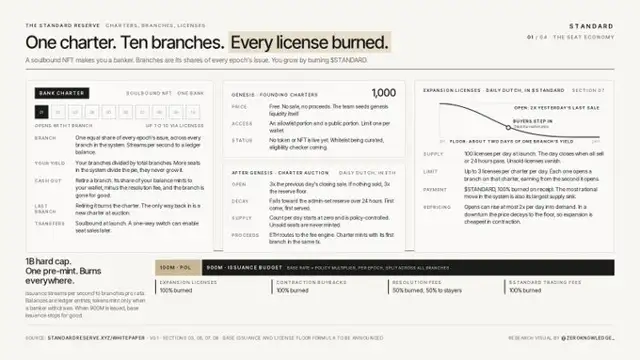
Bankers hold soulbound charter NFTs, 1,000 of which will be allocated through a free genesis mint, with the rest distributed through dutch auctions in $ETH as the protocol scales.
Every charter opens with 1 branch and can grow to 10. Branches matter bc each branch is one equal share of every epoch's issue protocol-wide.
So if there is 5000 branches in the system and you hold one charter NFT with one branch, you earn 1/5000 of the $STANDARD issuance for that epoch.
To add extra branches to your charter, you need expansion licenses that are sold in daily dutch auctions (100 per day at launch, max 3 per charter per day, and paid in $STANDARD that is 100% burned).
Over time, the auctions open at 2x yesterday's last sale, and from there decay to a floor of about two days of one branch's yield. Unsold licenses vanish.
But let's get to the key part.
The monetary policy.
The v4 hook on the liq pool counts $ETH in via buys minus $ETH out via sells each epoch. That net number is the sole determinant of the monetary regime:
- Net inflow = expansion: the issuance multiplier steps up one notch per epoch (raises must be earned) and fees route to the expansion vault, which buys tokenized gold as a hard reserve.
- Net outflow = contraction: the multiplier gets cut immediately and fees flip to the contraction vault, which buys $STANDARD on the pool and burns all of it in hourly rate-limited ticks capped near 5% of pool depth per day (automated buy and burn against sell pressure).
Issuance decisions use the trailing two epochs so one manipulated hour can't move the rate. Fee routing uses the current epoch's data tho, so defense reacts fast.
Every swap pays a fee in $ETH, buys and sells alike, and charter auction $ETH flows into the same engine. Split each epoch:
- 70% to the active vault (gold or buybacks)
- 15% to protocol-owned liquidity (half swapped to $STANDARD, paired and added forever)
- 15% to the team (gud payday kek)
The token itself has a 1B hardcap, and 100M $STANDARD are locked full-range into the v4 pool at genesis, plus every epoch's fee share on top.
Same "own your liquidity" thesis as $OHM, except the LP is permanent by construction and the treasury reacts to flow by hardcoded rules, not DAO votes.
The 900M $STANDARD not issued on day one is the issuance budget that branches earn over time.
The omni-present burns combat this issuance with tokens permanently removed from circulation through:
- Licenses (100% burn)
- Buybacks (100%)
- Resolution fees (50%)
- $STANDARD side of trading fees (100%)
Ok cool, but what about sell pressure from branches?
Valid question.
You only cash out by retiring branches.
Retire 1 of 10 and 1/10 of your balance mints to your wallet, minus a resolution fee, and that branch is gone forever.
Retire the last one and the charter burns. You hence can't harvest yield while still owning the yield source.
However, you can use your $STANDARD to acquire more branch licenses, and that's the core loop.
The most +EV move for an incumbent (compounding into more branches) is also the protocol's biggest supply sink.
And withdrawals (a.k.a. retiring a branch and claiming the earned $STANDARD) is not always cheap.
Because as mentioned above, exiting incurs a resolution fee, which is basically a congestion tax on the exit. As per whitepaper it's near zero on a quiet day, and steep in a run (if a lot of ppl are cashing out).
Definitely strong ponzinomics.
A few final remarks and thoughts:
No token or NFT is live yet and according to their announcement there will be no surprise launch, so pls don't get rekt.
The whitelist for the 1,000 Founding Charters is being curated rn and an eligibility checker is probably coming in the next days/weeks.
If you want to run one of the first thousand banks in this novel onchain reserve currency system, now is the time to pay attention anon.
NFA, DYOR.
If you're just coming across this, don't fade the moon maths modelling for @standard_rsv:
x.com/zerokn0wledge_/status/2091865606718947558
3 more images on X
What came next · since 23 Aug 2026
Show how the 2 covered assets moved
This explainer walks through how things work without making a call on the token, so price moves since publication are shown as market context.
Covered, no call
Mentioned for context
Since then
Zero has written 11 more pieces on $STANDARD since this one.
- Standard Reserve bull case: reflexive issuance and Robinhood Chain liquidityBullish call on $STANDARD
- Standard Reserve: adding branches after Mandate II and v1.1/v1.2 upgradesBullish call on $STANDARD
- Standard Reserve: why add branch licenses, Mandate II and the burn loopBullish call on $STANDARD
- Standard Reserve branch license auctions: 4.4M STANDARD burned in three daysBullish call on $STANDARD
Daily closes in USD from DefiLlama and Yahoo Finance. Only a bullish or bearish call in a thesis or market take is tracked; explainers, lists, maps and mentions are neutral context. Not financial advice.