
Privacy ecosystem map v2: private money, payments and programmable chains
Thread3,763 words
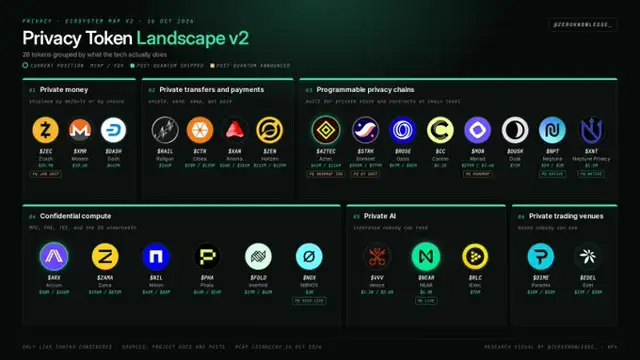
Privacy token map with mcap/FDV, 7d and 30d moves and distance from ATH across private money, payments and programmable chains. Notes 4.96M ZEC shielded (29.2% of supply, an ATH), Monero's FCMP++ stressnet and STRK up 193% in 30 days.
Key claims
4.96M ZEC shielded, 29.2% of supply
STRK +193% 30d, still 98% off ATH
Dash shielded transactions live on Evolution since 21 Aug
Shipped v1 of this privacy map last week and the replies were very helpful to come up with a more complete v2.
So here's the v2 ecosystem map (mcap/FDV, 7d and 30d moves and distance from ATH):
1) Private money
- $ZEC ($20.9B, +1% 7d, +1% 30d, 62% off ATH):
Zcash is optional privacy: you move coins into a zk shielded pool and from there nobody sees sender, receiver or amount. For years the problem was that hardly anyone bothered to shield. That changed: 4.96M ZEC sit shielded now, 29.2% of supply and an ATH, 4.1M of it in Ironwood, the new pool from July that Brave made its default on 8 Oct. On top, NU7 is on testnet since 4 Oct, the team presented Tachyon on 9 Oct (recursive SNARKs, ~150 TPS target), and ZCSH on NYSE Arca is the first spot ETF for a privacy asset anywhere. On quantum, hash-based signatures for the transparent pool are targeted for January, while the shielded pool needs its own migration (Epoch, end of 2027). There are no programs inside the pool tho. ZEC is private money and nothing else, which is also why it stays the asset the whole vertical is priced off.
→ DYOR: @Zcash
- $XMR ($10.6B, +5% 7d, +12% 30d, 30% off ATH):
Privacy by default instead of by choice. Ring signatures, stealth addresses and RingCT hide sender, receiver and amount on every single tx, no opt-in. The weak spot was always the ring itself: 16 members, so you hide among 15 decoys and a good heuristic narrows that down. FCMP++ replaces the ring with a proof that you own one of the 150M+ outputs on the entire chain, which makes the whole history your anonymity set. The third beta stressnet has been live since 5 Oct, hardware wallets and multisig don't work on it yet, and there is no mainnet date. Add that it's delisted on most regulated venues and has no ETF, and you get why it trades like ZEC's discount twin. FCMP++ is the catalyst, the missing listings are probs the ceiling.
→ DYOR: @monero
- $DASH ($643M, -2% 7d, -5% 30d, 97% off ATH):
Dash is the one I skipped in v1 and shouldn't have. It has had protocol-level CoinJoin since 2014, and on 21 Aug it went further: Orchard-based shielded transactions (Zcash's zk tech, Halo 2, no trusted setup) went live on the Dash Evolution chain, ~1s settlement, built in five months, shielded assets next. So it's now two privacy models in one coin, mixing on Core and real zk shielding on Evolution. The token still trades like it's 2018 tho, 97% off ATH and -5% on the month while ZEC ran, and most of CT has not noticed the upgrade. Either the market is right or it's late.
→ DYOR: @Dashpay
2) Private transfers and payments
- $RAIL ($156M, +2% 7d, +36% 30d, 54% off ATH):
Railgun has been live since 2021 and is still the most used private DeFi rail on Ethereum. It's a zk shielded pool on Ethereum, Arbitrum, BSC and Polygon, and the trick is that you call DeFi from inside the pool, so Uniswap or Aave never learn who you are. Private Proofs of Innocence let you show your funds are clean without doxxing them, which is what keeps it usable post Tornado. Blockworks put a dashboard on it on 7 Oct: $4.6M annualised revenue, staking yield up from 4.3% to 9.1%, weekly txs at an ATH of 5K.
→ DYOR: @RAILGUN_Project
- $CTR ($20M mcap, $135M FDV, +5% 7d, +18% 30d, 65% off ATH):
Citrea is the Bitcoin ZK rollup, and since 23 Sep also a privacy play: it acquired Crest, a self-custodial private BTC wallet, and made it the flagship product, pitched as Zcash-style privacy for Bitcoin. Mainnet is live (cBTC, ctUSD, Clementine bridge, security upgrade shipped 10 Oct), the numbers are small ($20M DeFi TVL, $4M ctUSD, 83 BTC in the vaults) and Crest itself is still a waitlist. So what you buy today is the rollup plus an option on private BTC, with 15% of supply floating. The cleanest private-Bitcoin ticker there is, mostly bc there isn't another one.
→ DYOR: @citrea_xyz
- $XAN ($26M mcap, $101M FDV, -10% 7d, -11% 30d, 96% off ATH):
Anoma does privacy as a consumer product. The architecture is intent-centric (you say what you want, solvers figure out how, privacy sits in the protocol), but what you actually touch is AnomaPay. V1 is live on Ethereum plus five EVM chains with 20 assets: shielded transfers, private yield accounts on Morpho, confidential swaps via Bebop, private payroll, private tokenized stocks on BNB, and since 6 Oct native private swaps. For normies this is probs the right abstraction, an app rather than a chain. It's also the cheapest optionality in the basket, bc it sat flat while everything around it ran (take that as you will).
→ DYOR: @anoma
- $ZEN ($113M mcap, $129M FDV, -3% 7d, -5% 30d, 96% off ATH):
Horizen went the compliance route. It's an EVM-native L3 on Base, and Vela, its confidential compute layer, lets an app keep its state private while disclosing exactly what a regulator asks for and nothing more. That is selective disclosure built for the EU and UK transfer rules, not anonymity, and it's a very different buyer than the ZEC crowd. 21M capped supply, ERC-20 on Base, staking live since July, a token-weighted Special Council elected end of Sep, first Vela accelerator cohort wrapping up this month. It has lagged ZEC the entire run, which you can read either way.
→ DYOR: @horizenglobal
1/4
3) Programmable privacy chains
- $AZTEC ($62M mcap, $214M FDV, +40% 7d, +63% 30d, 48% off ATH):
Aztec is the purest ZK answer to what Zcash can't do, which is programs. Private smart contracts written in Noir, proofs generated on your own device so the network never sees your state, decentralised sequencers and provers underneath. It had its hiccups, no point pretending otherwise: Alpha V5 shipped a critical proving bug (found in July, disclosed in Aug). Since then the core of the proving system got formally verified (1 Oct) and the V6 code is ready and in governance to head to mainnet since 9 Oct. Galactica is building the first private AI inference app on it, and Olla became the first V6 launch partner on 13 Oct with liquid staking of AZTEC live. On quantum, Zac called bunker mode hyperbolic and warned against rushing into untested crypto, so the security roadmap is still open. It's the only L2 doing full stack programmable privacy, which makes it both the highest beta but maybe also the highest execution risk in this section.
→ DYOR: @aztecnetwork
- $STRK ($592M mcap, $779M FDV, +7% 7d, +193% 30d, 98% off ATH):
A month ago this was a dead L2 token that happened to have a use case. The use case is STRK20, privacy at protocol level: shield and unshield in your wallet, private transfers, private swaps on Avnu against the same liquidity as public markets, private payroll on DashX, private staking of strkBTC via Endur, even private Polymarket trading, and since 13 Oct Shadow Accounts: a separate address funded from your shielded STRK20 balance so you can use public DeFi without linking it to your main wallet, first integration live 14 Oct. Selective disclosure with viewing keys rather than anonymity, a.k.a. the version institutions can actually use. Then the quantum trade landed on top. On 8 Oct Starknet said it is "actively considering becoming an L1" to be fully post-quantum by 2027, and since 15 Oct that is an actual vote: a non-binding Snapshot poll for STRK stakers on whether to research the L1 transition, open until 22 Oct, 316M STRK yes vs 0.2M no so far, STRK stays the token and the Ethereum bridges stay open either way. STARKs are hash-based already, and a phone signed a testnet tx with an ML-DSA key without a hard fork.
→ DYOR: @Starknet
- $ROSE ($67M mcap, $82M FDV, +5% 7d, +31% 30d, 99% off ATH):
Oasis has been running a confidential EVM chain since before it was a narrative. Sapphire keeps contract state and inputs encrypted even from node operators via SGX with remote attestation, and ROFL runs off-chain apps in SGX and TDX enclaves that Sapphire manages (bots, oracles, agents). You can deploy Solidity to it today. The team is the quietest in the basket (one substantive post in a month) and the token is 99% off ATH, so it is either the cheapest programmable privacy chain on this list or a dead project with working tech. Probs a bit of both.
→ DYOR: @OasisProtocol
- $CC ($4.1B, -16% 7d, +14% 30d, 47% off ATH):
Canton is the chain Wall Street actually settles on, and privacy is the reason. Need-to-know visibility, sub-transaction privacy, a synchronizer that orders transactions without ever seeing the terms. September alone brought Franklin Templeton and TreasurySpring as super validators, 10 new featured apps incl. Circle, and 442.6M CC burned through traffic. Since then LSEG became a super validator too (its DiSH already settles intraday repos on Canton), SoFi added native CC, and a Universal Burn CIP is in draft to route all synchronizer fees through CC burns. On 10 Oct the mainnet swapped its consensus engine to Canton BFT with 800+ nodes and almost no downtime, the network is moving $300B+ a day, and DTCC's tokenization service is the next shoe. Not privacy for CT, privacy that institutions pay for, in CC.
→ DYOR: @CantonNetwork
- $MON ($279M mcap, $2.4B FDV, -3% 7d, +8% 30d, 52% off ATH):
Monad wants the same lane. Private Settlement, announced 6 Oct, is a design for sovereign domains on the L1 where transactions, state and contract code are encrypted, even from the chain itself. The institution picks its validators and jurisdiction, access is denied by default with scoped access for auditors, and every domain still settles atomically against Monad's pooled liquidity. No fork, and no offchain components. Target customers are banks, treasuries, asset managers and OTC desks, a.k.a. the Canton pitch on a general purpose L1. There's also a post-quantum roadmap from 28 Sep with address-preserving key rotation, wallet auth and consensus in progress, encrypted mempool last.
→ DYOR: @monad
- $DUSK ($73M, +58% 7d, +82% 30d, 89% off ATH):
Dusk is the regulated-finance version of a privacy L1, mainnet since Jan 2025. Two transaction models on the same ledger, Moonlight for transparent flows and Phoenix for shielded ones, plus selective disclosure so a supervisor sees what they're entitled to and nothing else. DuskVM for Rust contracts, DuskEVM for Solidity with DUSK as gas, Citadel for credential-gated access. Ten core cryptography releases shipped on 9 Oct (PLONK proofs ~2x faster, new Poseidon, ElGamal, Schnorr and BLS libs). Same buyer as Canton, permissionless chain, at 1/56th of the mcap.
→ DYOR: @DuskFoundation
- $NPT ($1M mcap, $2M FDV, +8% 7d, +117% 30d, 98% off ATH):
Neptune Cash built privacy and post-quantum into the same L1 from genesis instead of retrofitting either. Hash-based STARKs on Triton VM as the validity layer, no trusted setup, no elliptic curves anywhere under the proof, and mutator sets so inputs and outputs stay unlinkable while the chain stays succinct. PoW, 42M cap, 1.98% premine, mainnet since Feb 2025 with a relaunch in Aug 2025 after an inflation bug (found before anyone exploited it as far as they know, legacy UTXOs redeemable). Shipping is steady: hardfork Δ on 24 Sep (chained txs, Triton VM v8), v0.19.0 on 1 Oct with 2 to 7x faster proving so a 64GB laptop can serve proofs, and smart contract code out for community feedback this month. The design is programmable (Triton VM proves arbitrary programs, lock scripts and type scripts are the contract model), which is why it sits here and not next to ZEC, even though today it is used as private cash and standing swap orders will be the first real contract. The catch is liquidity: one exchange (SafeTrade), ~$10K a day in volume. Real tech, no market (yet).
→ DYOR: @NeptuneCash
- $XNT ($1.5M, +110% 7d, +243% 30d, 47% off ATH):
Neptune Privacy is the friendly community fork of Neptune Cash from Nov 2025: same STARK plus mutator set stack, a different monetary policy (6.8 XNT a block tapering to a 1 XNT tail, 2.3M supply today) and none of the original devs. What it adds is Leviathan, an L2 for programmability on top of the private L1, with private smart contracts live on public testnet since 12 Oct and a post-quantum DEX and TEE-based private AI on the same testnet. Listed on MEXC, which NPT is not, which is probs why it is the one CT actually trades. $1.5M mcap so it's tiny, but it's also live.
→ DYOR: @NeptunePrivacy
2/4
4) Confidential compute (MPC, FHE, TEE)
- $ARX ($50M mcap, $240M FDV, -8% 7d, +47% 30d, 48% off ATH):
My main bet, so I'll keep it short. Arcium is an MPC network where nodes compute on data none of them can see, settled on Solana. Encrypted compute is live with five apps on mainnet (Umbra, Zinc, Bench, Rips, Crafts). C-SPL is coming: encrypted balances for any SPL token and programs that can own confidential accounts, a.k.a. the Zcash use case with programmability and composability on top. Blackthorn got its first real update on 8 Oct: the CPU TEE is out of the stack, the GPU's session keys are held as MPC shares, the host is untrusted and the Nvidia GPU runs the model in CC mode, so nobody sees plaintext even with physical access. That's basically the Venice use case with a better trust model. Neither product is fully live yet tho. However, ARX still trades 416x below ZEC and 24x below VVV on mcap. That gap is the trade.
→ DYOR: @Arcium
- $ZAMA ($196M mcap, $872M FDV, +4% 7d, +65% 30d, 28% off ATH):
FHE means computing on encrypted data without ever decrypting it, and Zama is the one that turned it into product. ERC-7984 confidential tokens are live on Ethereum mainnet: cUSDC, cUSDT, confidential Morpho vaults, confidential incentives on Merkl. GSR did the first confidential OTC trade on it, Bron ran confidential payroll, and it is the default confidentiality layer for T-REX Ledger. Shielded TVL passed $100M on 5 Oct, up from $85M two weeks earlier. The tradeoff is real tho: FHE is slow, and shared state still needs a threshold committee to decrypt. Still, it is the one confidential DeFi stack institutions are actually using today.
→ DYOR: @zama
- $NIL ($42M mcap, $83M FDV, -4% 7d, +104% 30d, 91% off ATH):
Nillion is making one of the most interesting pivot in the basket. The base layer is blind computation, data split across nodes and computed on with MPC and HE so no node ever holds plaintext. The product on top is Encrypted Markets, built around Covenants: an encrypted instruction that decrypts itself when its condition is met, with no operator holding the key. Dusk, the first phase, went live on Ethereum mainnet on 6 Oct, Blacklight L1 nodes are up on Ethereum (70k NIL min stake, rewards from 0.5% inflation plus trigger fees), Darkfall extends Covenants across the EVM next, Hyperliquid integration planned.
→ DYOR: @nillion
- $PHA ($46M mcap, $54M FDV, -11% 7d, +107% 30d, 96% off ATH):
Phala is the hardware side of private AI. Phala Cloud runs private LLM inference, sealed agents and GPU jobs on Intel TDX plus Nvidia H100, H200 and B300 confidential GPUs, attestation included, 5k+ users, SOC 2. It is one of the two enclave providers behind Venice's end to end encrypted mode, and the execution layer under Rift, the Paradigm-backed onchain execution API that launched 1 Oct. Migrated from Polkadot to Ethereum last Nov. The tradeoff is the same as for every TEE: you trust the chip/vendor.
→ DYOR: @PhalaNetwork
- $FOLD ($17M mcap, $62M FDV, -16% 7d, -2% 30d, 70% off ATH):
Interfold is confidential computation for Ethereum: private inputs, verifiable outputs, no trusted hardware, via E3s (encrypted execution environments) run by a ciphernode network. The first mainnet E3 went live on 9 Oct, operators had to upgrade to v0.19 ahead of the next one, and FOLD landed on Blockworks' Token Transparency Framework and Bloomberg Terminal on 13 Oct. It lists itself next to RAIL, ZEC, ZAMA and AZTEC, and the tech sits closest to Arcium's lane, on Ethereum. Very early tho and one E3 live.
→ DYOR: @theInterfold
- $NOX ($2M, -10% 7d, -32% 30d, 80% off ATH):
NØNOS is the odd one out, flagged in the replies as the layer below everything else: the OS. A Rust microkernel where the kernel and every program are signed, measured and proved before they run, with Ed25519 plus ML-DSA-65 on every signature (you'd need a classical and a quantum break to forge one) and a hash-based STARK attestation of the kernel. Shielded transfers settle on Ethereum, on testnet today, Nym mixnet and local Qwen inference ship as first-party apps, v0.9.2 is out. NOX is an ERC-20 with no mint and fee-based rewards. $2M mcap, so this is kind of a research project with a ticker still, not a trade you can enter with size. And while it sounds very interesting, there is the risk that if the OS leaks, everything above it is theatre. It's the only team on this list working on this approach tho too, so def worth watching.
→ DYOR: @nonossystems
3/4
5) Private AI
- $VVV ($1.2B mcap, $2.0B FDV, +11% 7d, +11% 30d, 29% off ATH):
Venice is the consumer front end of private AI. In end to end encrypted mode your prompt is encrypted on your device, decrypted only inside a GPU enclave at NEAR AI Cloud or Phala, and you get an attestation proof back. Claude Opus, Sonnet and Haiku 5.5 are all available anonymously now. Staking gives you a pro-rata share of API capacity and mints DIEM, $1 of API credit per day in perpetuity. Emissions stepped down from 2.5M to 2M VVV a year on 1 Oct, the largest discretionary burn to date ($414K) ran on 7 Oct, it got listed on Solana via Sunrise, and the $65M Series A at $1B closed in July. The only name here with revenue at scale. Trust model: the chip and the vendor. -14% last week, +11% this week, so the dip got bought; still 29% off ATH if you believe in the narrative.
→ DYOR: @AskVenice
- $NEAR ($6.9B, +12% 7d, +118% 30d, 74% off ATH):
NEAR is the rail under Venice and the chain that actually did the quantum homework early. NEAR AI Cloud runs inference in hardware enclaves with Intel Trust Authority attestation, is a provider on OpenRouter now, and Venice chose it for encrypted inference. On near(.)com deposits are confidential by default, you hold stocks, gold and perps confidentially, and Hyperliquid perps run with the link between funding wallet and trading account hidden. On quantum: anyone can add an ML-DSA key to their account on mainnet in one tx and keep the account, NEP-655 hash-committed accounts are on testnet with mainnet in weeks, and a Q-day recovery registry for other chains is in the works. Plus a live proposal to cut issuance from 2.5% to 1.6%. Six years on mainnet as of 13 Oct, $3B+ of confidential intents volume and $150M+ confidential TVL. Not cheap after +118% in a month, but it's the only large cap where privacy and post-quantum are shipped rather than promised.
→ DYOR: @NEARProtocol
- $RLC ($75M, -18% 7d, +218% 30d, 94% off ATH):
iExec has been a confidential computing marketplace since 2017 and now sells itself as the rail for confidential AI. Apps and agents run inside TEEs on Arbitrum, DataProtector decides who may process a dataset without ever revealing it, Web3Mail lets you message a wallet without learning its email. The framing is correct, encryption at rest and in transit is solved and in use is not, but there is no new product milestone this month. The tripling came on the narrative and an Aster perp listing.
→ DYOR: @iEx_ec
6) Private trading venues
- $DIME ($10M mcap, $52M FDV, +23% 7d, +279% 30d, 49% off ATH):
Paradex runs privacy options (and perps) on its own Starknet-stack L2. Orders, positions, PnL and liquidation levels are hidden, the RPC only hands your data to you after a signed request, and state goes to Ethereum as encrypted diffs with ZK verification. The caveat: a three member Privacy Council (Paradex Foundation, Paradex, Karnot) holds the decryption keys as an escape hatch. Zero fees, unified margin, and options are the story now: 20% of onchain options notional since the Paradigm RFQ launch, $430M options volume in three weeks, OI past $550M, four new RWA markets. Nobody can read your book, so nobody can trade against it, and no other live perp DEX with a token offers that. Up ~4x in a month so the easy part of PA is done, but it still sits at a fraction of the FDV of any DEX running similar OI.
→ DYOR: @paradex
- $EDEL ($21M mcap, $30M FDV, -17% 7d, +11% 30d, 73% off ATH):
Edel is the Canton-native take on the same idea. Edel Markets is the perp DEX, not live yet, with positions and orders private by default through the network's need-to-know model instead of bolted on. What is live is Edel Stocks: SPYe, QQQe, NVDAe and SPCXe, issued by Edel itself as an approved Canton asset issuer, trading on Cantex when Wall Street is closed, $3M+ cleared on the two ETFs in under ten days. Worth knowing what you hold tho: these are 1:1 economically backed debt instruments, not share claims, and only KYB'd institutions can mint or redeem them in USDCx. EDEL staking routes part of the revenue to holders in CC, tiers announced for this month. Seat in the DTCC Digital Assets Industry Working Group, and a Swiss team. It's the only tokenised Paradex peer (even tho Paradex is more an options venue than a perp DEX at this point), bc Ekiden and Hibachi, the other private-by-default venues, have no token yet.
→ DYOR: @edeldotfinance
All NFA tho ofc. DYOR. And lmk if I missed any projects.
4/4
And pls note that this only includes projects with a live token why some stuff is still not on the list.
Might do a separate "pre-TGE watchlist" later.
There will also be a major report on the privacy vertical by @a1research__ dropping next week btw 👀
Recommend to drop a follow and turn on 🔔
How the mapped assets moved · since 16 Oct 2026
Prices as of 23 Oct 2026This is a landscape piece, not a set of calls. Price moves since publication are shown as market context.
Mapped in this piece · best to worst since
$CTRCitreasince publication+21%+22% vs BTC
$DASHDashsince publication+10%+11% vs BTC
$ZENHorizensince publication+1.7%+2.2% vs BTC
$XANAnomasince publication−11%−10% vs BTC
Since then
Maps are snapshots; see each asset's hub for later coverage.
Daily closes in USD from DefiLlama and Yahoo Finance. Only a bullish or bearish thesis is read as a call; explainers, maps and mentions are context. Not financial advice.