
Shared sequencing research report: 10 key findings (with Pansophic)
Thread1,001 words
TLDR of a 45-page co-authored report: sequencing is centralized and siloed today, decentralized and shared sequencing are separate axes, and shared sequencing offers decentralization-as-a-service and limited atomic composability.
Key claims
Today each rollup runs a single centralized sequencer, creating SPOF, MEV and censorship risks
Shared sequencing without execution guarantees offers limited composability value
Large ecosystems may keep sequencing in-house given how lucrative it is
We are entering the era of rollups!
The demand for modular infrastructure components like shared sequencing layers is set to explode!
🌐 Decentralization-as-a-Service
🔒 Pooled Crypto-Economic Security
🚀 Atomic Composability
This tech will reshape how we build rollups! 🤯
🧵
With @Pansophichad I have co-authored an in-depth research report on shared sequencing.
On 45 pages of alpha, we cover:
🔹 Rollup Mechanics
🔹 State of Sequencing
🔹 Core Concepts & Terminology
🔹 Shared Sequencing Solutions
🔹 Financials of Sequencing
🔹 Sequencing Research
In this TLDR thread I will walk you through the 10 key findings of our report.
Find the full report here! 👇
x.com/zerokn0wledge_/status/1719682371539337506
1️⃣ The current sequencer landscape or the state of rollup sequencing more broadly is still in a very nascent stage.
What I mean by this is that rollup sequencers are currently run in a centralized and siloed manner by the teams (one sequencer per rollup).
This introduces risks and drawbacks that are inherent to the centralization and siloed nature of the design:
⚠️ Single Point of Failure
⚠️ MEV Exploitation Risk
⚠️ Weak Censorship Resistance
⚠️ Weak Liveness Guarantees
⚠️ No Atomic Composability
⚠️ No Pooled Security
It is hence essential to have mechanisms in place to address the risks that come with this centralized design.
Arbitrum's escape hatch is one such mechanism that provides users with a way to exit the network without loss of funds should the sequencer try to censor or go down.
2️⃣ It's important to distinguish decentralized sequencing from shared sequencing.
A centralized sequencer can serve many rollups, while a decentralized set of sequencers can serve only one network or only a specific set of rollups.
The differentiation here should hence be two-fold:
🔹 Centralized vs. Decentralized
🔹 Siloed vs. Shared
Centralized vs. Decentralized primarily addresses questions around:
⚠️ Single Point of Failure
⚠️ MEV Exploitation Risk
⚠️ Weak Censorship Resistance
⚠️ Weak Liveness Guarantees
A decentralized set of validators (sequencers) that implement a leader rotation mechanism or a fully-fledged PoS consensus mechansim.
This offsets the risks arising from a single point of failure in the siloed, centralized approach.
Additionally, the increased number of nodes improves the liveness guarantees, and depending on the design, also strengthen censorship resistance.
Using sophisticated cryptographic technologies, MEV exploitation risks can also be addressed within a decentralized (and potentially shared) sequencing layer.
One such approach we explain in detail in our report is @radius_xyz.
Siloed vs. a shared approach on the other hand is a decision that mainly evolves around two limitations of the siloed design:
⚠️ No Atomic Composability
⚠️ No Pooled Security
3️⃣ The sequencer is key to enable a fast and seamless UX!
As L2 wars heat up and as the modular narrative continues to gain traction, the competition among modular rollup execution layers will be fierce.
Soft finality guarantees (a promise that transactions will be included in a L1 block eventually) are what enable the UX that makes everyone love L2s.
Centrally run sequencers on high-spec machines have an edge here but using high performance consensus mechanisms or simple leader election schemes, sequencing layers can provide a blazing fast UX as well.
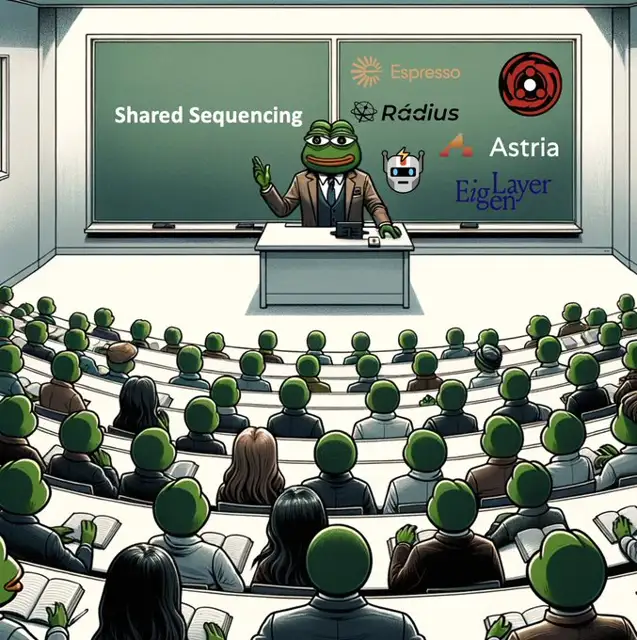
4️⃣ There is a number of interesting projects building shared sequencing networks that will likely be among the cornerstones of a modular future.
In the report we have a closer look at 👇
⚙️ @EspressoSys
Hotshot consensus based shared sequencing layer running on a proprietary decentralized validator set that provides fast soft finality guarantees and comes with an out-of-the-box DA solution.
⚙️ @AstriaOrg
Using a Tendermint-based leader election mechnaism, Astria ensures liveness and mitigates the risk of a single point of failure through a decentralized network of sequencers, while providing fast soft finality to enable a seamless UX.
⚙️ @radius_xyz
Innovative shared sequencing layer that relies on a leader rotation mechanism. Radius uses Practical Verifiable Delay Encryption (PVDE), enabling an encrypted mempool and making the sequencing layer mEV-resistant.
⚙️ @MadaraStarknet
Madara is the sequencer used within the StarkNet L2 framework. It allows for great flexibility & can be run in both a centralized and decentralized variant. It's built upon the Substrate framework and uses the Grandpa and Babe consensus mechanism by Polkadot.
⚙️ @eigencloud
Another approach that has recently gained attention is the use of middleware services that leverage the existing Ethereum validator set and trust network for security through a restaking mechanism. This approach is being pioneered by EigenLayer.
⚙️ SUAVE by Flashbot:
SUAVE is quite different from the other shared sequencers (SS) discussed here. But as a shared, MEV-aware builder, it can be a great complement to SS (proposer), improving security guarantees in the context of cross-chain MEV & cross-rollup atomicity.
5️⃣ Network effects will play a big role here, especially due to the interoperability that shared sequencing enables.
Thanks to having transactions ordered into one block, a limited degree of atomic composability is enabled.
However, the lack of execution guarantees significantly impacts the value that this actually creates if not combined with additional tech such as cross-rollup messaging protocols or proof aggregation layers.
With increasing adoption of shared sequencing layers, the importance of the interoperability aspect will further increase and it will become a key factor in the decision making of projects looking for a sequencing layer.
6️⃣ Shared Sequencing is Decentralization-as-Service for the long tail of rollups / modular chains.
Spinning up and maintaining a decentralized set of sequencers can be a complex and expensive endeavour.
Hence, the modular plug and play solution shared sequencers offer, are specifically attractive to smaller (app-specific) rollups with potentially less resources and a greater need for cross-rollup composability.
But even larger rollup ecosystems like @arbitrum have already announced partnerships with shared sequencers like @EspressoSys.
x.com/EspressoSys/status/1701318209624834466
7️⃣ Sequencing is very lucrative. The large rollups will likely want to keep that value within their ecosystem.
We are expecting many decentralized but siloed sequencing approaches to emerge focused on specific ecosystems only (OP Superchain or Polygon CDK Universe).
With @MetisDAO, @CeloOrg or @aztecnetwork, other (upcoming) rollups are also working on decentralized sequencing mechanisms.
10 more images on X
What came next · since 01 Nov 2023
Since then
Zero has written 2 more pieces on Espresso since this one.