
Celo's L2 migration: OP Stack vs Polygon CDK vs ZK Stack compared
Thread1,058 words
Compares OP Stack, Polygon CDK and ZK Stack proposals for Celo against criteria such as EigenDA support, decentralized sequencing, EVM equivalence, validity proofs and interop. Favors Polygon CDK or OP Stack.
Key claims
Celo has 4M active addresses (+190% YoY)
Polygon CDK offers near bytecode compatibility and live ZK validation
Starknet unlikely due to fractal L3 focus and non-EVM CairoVM
Celo is moving to an @eigencloud-powered L2! ✨
@CeloOrg's green EVM L1 is on 🔥 with 4M (+190% YoY) active addresses & a Daily Active User growth of over 3,200% YTD! 🚀
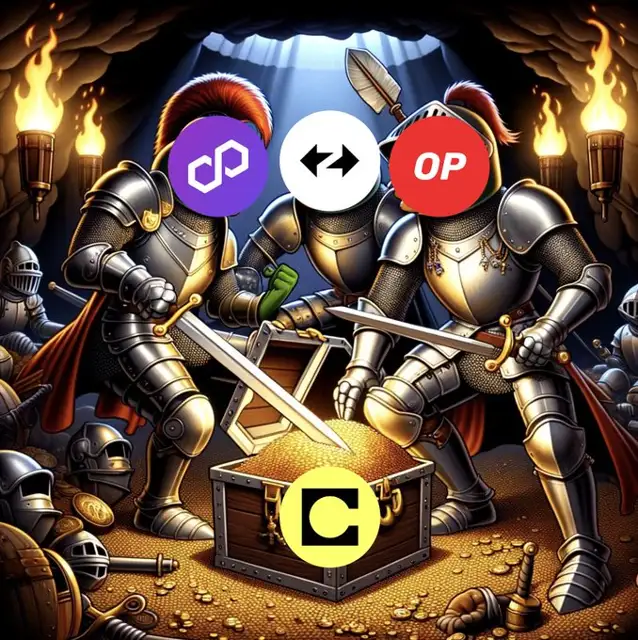
OP Stack, Polygon CDK & Matter Labs' ZK stack are all competing to get this giant onboard! ⚔️
Stack Wars 🧵
In this thread I will walk you through:
🟡 Celo Today (L1)
🔮 Celo Tomorrow (L2)
🚀 L2 Requirements
🔴 Original Proposal (OP Stack)
🟣 Polygon Proposal
⚡️ Matter Labs Proposal
🌐 Alternatives
🔍 Conclusion
Let's dive in! 👇
🟡 Celo Today
@CeloOrg is a strongly mission-driven, EVM compatible Proof of Stake L1.
It distinguishes itself from other alt-L1s with its strong focus on sustainability and impact.
🔮 Celo Tomorrow
While today @CeloOrg is running on its own proprietary validator set, it will soon transition to a L2 on Ethereum.
The long term vision is to become a fully modular zkEVM using EigenDA for DA and implementing a mechanism for decentralized sequencing.
🚀 L2 Requirements
⚙️ Allow for EigenDA
The tech stack needs to be modular and allow @CeloOrg to plug into EigenDA for data availability.
⚙️ Allow for decentralized sequencer
The tech stack needs to allow for decentralized or shared sequencing integration (e.g. Espresso).
⚙️ EVM Equivalence
The execution environment needs to be highly EVM equivalent, ensuring minimal friction for builders and users.
⚙️ Validity Proof based State Validation
Long-term vision is to become a fully trustless zkEVM.
⚙️ Pay Gas fees in token (e.g. CELO)
Self-explanatory, but requires low cost base (EigenDA) and potentially AA support.
⚙️ Interoperability
Cross-chain composability & liquidity access.
⚙️ Ecosystem
Integrate Celo into an ecosystem of (app-specific) rollups.
⚠️ Please note that this the above is based on the recent framework proposal by cLabs but is adjusted to reflect my personal view.
⚠️ Also, this is purely educational content!
🔴 Original Proposal (OP Stack)
⚙️ Allow for EigenDA
Possible. OP Bedrock is highly modular and allows for custom DA solutions.
⚙️ Allow for decentralized sequencer
Possible. Sequencer can be configured in SystemConfig contract.
⚙️ EVM Equivalence
Optimistic VM is highly EVM equivalent (bytecode level), introducing almost no friction compared to Ethereum L1.
⚙️ Validity Proof based State Validation
Currently, there is no live state validation mechanism. While optimistic fraud proofs are under development, validity proofs will be added in the future.
⚙️ Pay Gas fees in token (e.g. CELO)
Possible to have CELO be native currency and pay fees in other tokens through ERC-4337 (AA).
⚙️ Interoperability
Shared sequencing and cross-rollup messaging enables a unified, interoperable ecosystem of OP chains in the Superchain vision.
⚙️ Ecosystem
The OP Stack universe is among the leading rollup ecosystems. Big names like Zora, Manta, Worldcoin, DeBank or Aevo are building on Bedrock!
🟣 Polygon Proposal
⚙️ Allow for EigenDA
@0xPolygon CDK allows for customized DA solutions to be integrated, as well as a proprietary DAC.
⚙️ Allow for decentralized sequencer
Polygon has a proprietary shared & decentralized sequencing mechanism. Customization is possible.
⚙️ EVM Equivalence
While not fully EVM equivalent, @0xPolygon's zkEVM codebase is almost on bytecode compatibility level. Solidity based applications should run with (almost) no adjustments.
⚙️ Validity Proof based State Validation
@0xPolygon is a leader in ZK proving tech. Plonky2 (and soon 3) are among the most efficient proving systems, while live zk-based state validation is live on mainnet.
⚙️ Pay Gas fees in token (e.g. CELO)
Possible to have CELO as native currency and potentially support other currencies through ERC-4337.
⚙️ Interoperability
Proof aggregation layer that aggregates validity proofs across CDK chains, settling overall state in aggregate on L1. Seamless composability & liquidity access through shared ZK bridge.
⚙️ Ecosystem
Major players like Canto, Astar, X1 or Manta (in the future) are building on @0xPolygon CDK already and the ecosystem grows quickly.
⚡️ Matter Labs Proposal
⚙️ Allow for EigenDA
Possible to integrate with alternative DA solutions. There is also a @zksync DAC and a volition implementstion (mixed DA).
⚙️ Allow for decentralized sequencer
It is possible to opt for a decentralized and/or shared sequencing solution.
⚙️ EVM Equivalence
EVM-compatible but not equivalent. EVM code can be compiled down to Zinc and run inside @zkSync's VM, but migration comes with some overhead.
⚙️ Validity Proof based State Validation
@zkSync era was the first zkEVM live on mainnet. Boojum is a highly efficient, hybrid (STARK/SNARK) proof system similar to plonky. ZK-based state vaildation live on mainnet.
⚙️ Pay Gas fees in token (e.g. CELO)
Possible to have CELO as native currency and thanks to native AA, it's easy to have users pay fees in any token.
⚙️ Interoperability
ZK-powered hyperbridges will make ZK Stack chains seamlessly interoperable.
⚙️ Ecosystem
With the ZK stack just having launched publicly very recently, the ecosystems still in its early stages and is missing big names at this point.
🌐 Alternatives
It will be interesting to see if other players like @arbitrum or @Starknet will join the @CeloOrg Stack Wars.
A L2 based on the @arbitrum Nitro codebase is definitely be interesting as well as an intermediary step to a zk-powered validity rollup.
Arbitrum's Stylus VM (WASM) and the live fraud proving mechanism make Nitro a highly advanced optimistic rollup codebase.
Additionally, BOLD as a permissionless challange rotocol to decentralize fraud proving is in the pipeline, further strengthening Arbitrum's lead on the tech.
However, building an @arbitrum L2 requires a license from the DAO (which I could very well get Celo get though).
A permissionless L3 with off-chain DA (Orbit chain) is less likely in my opinion.
That is also why I think @Starknet will likely not be @CeloOrg's choice, even if they join the wars.
Firstly, they are focused on fractal scaling through L3s. Celo wants to be a L2.
Secondly, the CairoVM, while highly scalable, is not EVM equivalent, which is a key criteria.
🔍 Conclusion
Personally, I believe the most well suited tech stack option for Celo is either @0xPolygon's CDK or the OP stack.
🟣 The case for Polygon:
👉 High degree of EVM equivalence
👉 Cost-efficient proof aggregation mechanism
👉 ZK-powered interoperability framework
👉 Leading zk proving technology (go zkEVM directly)
While Matter Labs' ZK Stack offers similar functionality, it has a lower degree of EVM equivalence.
Polygon's CDK is one of the most advanced zkEVM solutions, with a cutting-edge proof system (plonky) that is live on mainnet.
What came next · since 02 Dec 2023
Show how the covered asset moved
This breakdown analyzes the project without making a call on the token, so price moves since publication are shown as market context.
Covered, no call
$CELOCelosince publication−85%−93% vs BTC
Since then
Zero has written 3 more pieces on Celo since this one.
Daily closes in USD from DefiLlama and Yahoo Finance. Only a bullish or bearish call in a thesis or market take is tracked; explainers, lists, maps and mentions are neutral context. Not financial advice.