
Make ICOs Great Again: how VC-dominated token launches broke crypto markets
Thread1,073 words
Market since$ZK−89%since this pieceHow it played out ↓Long argument that VC-dominated cap tables, low float and high FDV launches and market maker dynamics shift value from communities to insiders. Calls for regulated ICO platforms with KYC and reputation systems, using zkSync as the example.
Key claims
zkSync launched at about $5B-$6B valuation, giving VCs more than 100x gains
ZK token lost more than 60% of value since launch
Matter Labs laid off 16% of its workforce
VCs have broken crypto markets.
To fix this, we have to Make ICOs Great Again.
We need to shift value accrual from VCs back to the community or most protocols will die.
Here is how & why. ⤵️
A key problem in today's crypto market for most of us as retail investors is how the "high tier" projects go to market.
They normally take on a lot of venture capital at low valuations in the early days, and most of the price discovery of these new tokens happens in private markets.
Through pre-seed, seed, strategic rounds, series A and so on, the valuation continues to go up, and far too often reaches its peak when the token hits public markets, launching at multi-billion dollar valuations already.
That also means these projects have A LOT of financial capital to do marketing and pay influencers in order to build hype around point programs, which help them generate stats to show that they have "adoption".
In combo with the capital already raised, this helps them raise even more private rounds at even higher valuations and to negotiate with CEXes, get T1 listings, and onboard market makers (MMs).
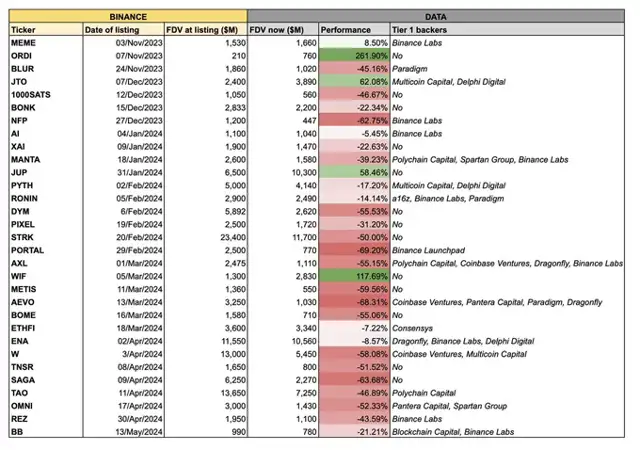
The never-ending appetite for investments of the VC firms has led to strongly VC-dominated cap tables, resulting in what has become known as low float/high FDV tokens (see visual below).
Projects normally give a large part of this already low float to the before-mentioned MMs, which can then control and manipulate price while having no fees trading on the CEX (= making a lot of money).
The MMs sustain the highly inflated launch valuations for short periods of time, and let retail get in.
Subsequently, ongoing vesting of founders, team and profit-taking VCs will continue to push the price & market cap down in most cases.
This strongly goes against the idea of democratization that was the basis of the original ICO concept that aimed to enable access for anyone at any stage of the fundraising process.
Greed, fraud and spectacular failures have killed ICOs and turned crypto into a "silicon valley"-style VC game.
While that's great for tier 1 teams and VCs that already sit on obscene gains when the token goes public, the end users, the real evangelists of the product, and the people that will make or break the project in the long term, get burned badly.
A recent example is @zksync, which launched at a valuation of around $5B-$6B, providing VCs >100x gains and creating instant sell pressure.
A poorly executed $ZK airdrop that largely rewarded insiders only added to the selling pressure and overall community disappointment.
With no community, the token has lost >60% of its value since launch and the flagship product zkSync Era remains without any meaningful adoption.
@the_matter_labs recently even laid off 16% of the work force. Meanwhile, @zksync has started to use heavy financial incentives (available thanks to the VCs) to bring builders into the ecosystem (indicating that they otherwise struggle to do so).
However, @zksync is definitely not unique in this regard.
Unfortunately.
The data below from @Binance listings between Dec 2023 and May 2024 impressively proves this sad fact.
Needless to say, that most of these performances look even worse today with the market down only for already 6 months straight basically.
This insider/VC game kills the adoption of decentralized systems and ultimately, the potential for these networks to scale sustainably.
Disruptive innovation on top of decentralized networks is not just about the technology alone.
There needs to be a community or early supporters to push the product, technology or ecosystem forward.
Projects that are successful in evangelizing their early supporters and building a strong community, are well-positioned for long-term growth.
What is key here, is that early supporters also need to have the opportunity to "make it" along the insiders and VCs.
Financial opportunity, like being able to buy in at low valuations in early rounds, (good!!!) airdrops and (effective!!!) grant programs are powerful tools to incentivize and bind users, builders and evangelists in the long-term.
If the value only (or to 99%) accrues to insiders and VCs that dump on "the community" with 100x gains at inflated FDVs in the billions of dollars, there will be no community.
There will no evangelists and hence no one to drive long-term adoption of the product.
Projects that don't have this community basis will have a hard time to organically grow and sustain themselves once they run out of their VC funding and artificially induced hype (see earlier $ZK example).
But since founders, teams and VCs will already be set for life by then, who really cares... right....?
That's why the system is fundamentally f**ked.
So what is the point of my post here?
TL;DR is that community matters and as opposed to code, it can't be forked. That's why projects have to put in an effort to build it and more importantly, bind it in the long-term.
Cool marketing alone doesn't do the job.
Obviously financial opportunity alone won't either.
But it needs to be part of the equation.
More community, less VC.
Don't get me wrong though.
VCs are not all bad, and some of them add real value.
But the market structure is heavily skewed into their (and insiders') favour.
The ones to pay for their gains are the communities that we fail to build and that we lack to push adoption forward.
Crypto should be about participation and inclusion.
It's technology that allows open innovation to flourish.
That finally enables efficient funding of open-source software.
But to succeed, we need (regulated) ICOs to come back.
We need platforms and mechanisms that allow tier 1 protocols to go bring their tokens market in a regulatory compliant manner, while allowing early supporters and the community more broadly to participate in the upside too.
Regulated platforms that solve the adverse selection problem in the ICO markets, and that not only level the playing field and give retail investors a real chance to make it (by investing into T1 projects early), but also provide projects efficient ways of finding "value add" investors (e.g. reputation systems) and meeting regulatory criteria (e.g. KYC) throughout the process without taking on prohibitively high risks and overhead.
That's why we need ICOs back and how we will make communities great (and rich) again.
In that sense: WAGMI!
Share to make builders aware. 🫡
Not sponsored but inspired by @legiondotcc.
Check it out. ⤵️
x.com/legiondotcc/status/1826648327888449761
3 more images on X
How the covered assets moved · since 14 Sep 2024
Prices as of 23 Oct 2026This piece lays out a thesis on the sector without making a call on the token, so price moves since publication are shown as market context.
Covered in this piece
Since then
Zero has written 1 more piece on zkSync and $ZK since this one.
Daily closes in USD from DefiLlama and Yahoo Finance. Only a bullish or bearish thesis is read as a call; explainers, maps and mentions are context. Not financial advice.