
Is EIGEN undervalued? Intersubjective security and valuation math
Thread1,434 words
Explains why EIGEN sold off, how its intersubjective forking security and dual-token design work, then values it with a PE-100 model. Concludes EIGEN is massively undervalued, with $20B plausible if AVSs reach a $5B to $10B combined market cap.
Key claims
EIGEN at $3.2 and $5.3B FDV vs $15 OTC implying $25B
PE of 100 implies $53M earnings; $20B needs $400M revenue
OMNI FDV $876M and ALT $1.1B
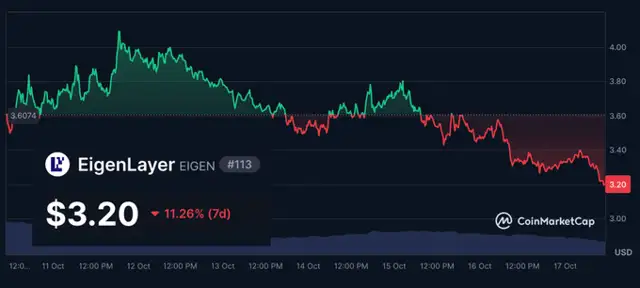
While $BTC is in up only mode, $EIGEN is down >11% on the week.
After trading at up to $15 OTC a few months ago, which implied an FDV of $25B, $EIGEN currently sits at $3.2 (FDV of $5.3B).
➊ Why is the price dumping?
➋ WTF even is $EIGEN?
➌ Is $EIGEN undervalued?
Let's find out. ↓
➊ Why is the price dumping?
The narrative around low float / high FDV launches with most of the value captured by the VCs between seed stage and public listing, has noticeably cooled down, not to say turned hostile, in the past months.
People are tired of infrastructure and especially of the down-only PA of basically all major launches in 2024.
Tired of tokenomics that favour the VCs and early investors that realize a 5x profit through staking rewards on their locked tokens before even starting to sell the tokens they originally bought.
In the meantime, people are making 100x on memecoins left, right and center, and the "memecoin supercycle narrative" continues to flourish on the disappointed hopes of the airdrop farmers and TGE day buyers of $STRK, $ZK, $MANTA and co.
All of that doesn't help the overall sentiment towards $EIGEN, which has suffered under the sell pressure of airdrop receivers from day 1.
$40M worth of unlocks on the 15th accelerated the downfall, and with the concept of an "intersubjective work token" just being too complex to understand for many, there is few that actually care about the $EIGEN token right now, creating a weak demand side.
That many seem to look at @eigencloud like a DeFi protocol and try to tie the $EIGEN valuation to the TVL in its contract, is another piece of evidence that few understand how this ecosystem actually functions and what $EIGEN's role within that system is.
Coupled with increasing competition in the "shared security" game, people were hence quick to move their attention elsewhere.
A big mistake as the ones that understand @eigencloud already know. If you don't, keep reading.
➋ WTF even is $EIGEN?
To understand the token, we have to first understand the protocol.
And no anon, this is not about DeFi.
@eigencloud is a decentralized cloud platform for crypto-economic security. It lowers the barriers of entry for builders of what is called "Actively Validated Services", by abstracting the need for them to bootstrap and maintain a proprietary, decentralized network.
This enables an ecosystem of hyper-specialized infra services for rollups/apps, which for example includes:
➤ @eigen_da (data availability)
➤ @eoracle_network (oracles)
➤ @witnesschain (DePIN coordination)
➤ @alt_layer (RaaS)
➤ @lagrangedev (zk proving)
➤ @OmniFDN (interop)
➤ @hyperlane (interop)
➤ @EspressoSys (rollup coordination/composability)
➤ @nufflelabs (fast finality
➤ @radius_xyz (rollup coordination/composability)
➤ +++
For a more comprehensive ecosystem of the AVS ecosystem, check the overview linked in the comments.
The crypto-economic security that is allocated to protocols building on @eigencloud, is derived from the $ETH restaked in its contracts, as well as $EIGEN and potentially even additional tokens that the individual AVSs choose to add through @eigencloud's permissionless token support feature.
Within the overall crypto-economic security system that @eigencloud provides, $EIGEN serves the purpose of addressing intersubjective faults.
Intersubjective faults arise when there is broad agreement among observers that something is wrong, but it cannot be definitively proven on-chain.
An example is when an oracle reports the price of 1 USDC as 100 USDT, while widely considered incorrect, this mistake cannot be conclusively proven through on-chain mechanisms though.
These faults rely on social consensus for attribution and slashing, a process that incurs significant cost.
A potential problem in the context of Eigenlayer, as @VitalikButerin has suggested that Ethereum’s social consensus should be reserved for critical network-level threats only.
To address this @eigencloud uses $EIGEN to provide intersubjective security to its Active Validated Services (AVSs).
AVSs must establish their intersubjective slashing conditions during setup.
For instance, an oracle AVS like @eoracle_network could penalize an operator if the reported price deviates by more than 10% from the observable market price.
Intersubjective security is then ensured through an $EIGEN forking mechanisms.
If an AVS is compromised by a malicious operator, a user can trigger a challenge.
The challenger launches a fork of the token, burning both their own stake and the offending operator's stake.
Since the fault is observable by the community, the challenger can expect support for their fork.
Conversely, if the operator is innocent, their version of the token will be favored by the community.
@eigencloud governance determines the minimum number of tokens that must be burned in such challenges, setting a threshold to deter malicious disputes.
This is a very unique design, also due to its dual-token model.
Traditionally, forking poses significant challenges for DeFi ecosystems, especially for ERC20 tokens.
Forking a native asset like $ETH results in two parallel versions of the ecosystem, but forking ERC20 tokens can significantly disrupt lending positions and DEX liquidity pools.
That's what @eigencloud's dual token model prevents:
➤ Fork-aware token ($bEIGEN or backing-$EIGEN): This token is staked for AVS security and will fork into different versions (e.g., $bEIGEN1 and $bEIGEN2) during a challenge. The community will adopt the intersubjectively correct version of $bEIGEN.
➤ Fork-unaware token ($EIGEN): Unstaked $bEIGEN can be wrapped to create $EIGEN. $EIGEN tokens, derived from legitimate $bEIGEN, retain their value and usability across DeFi, ensuring that they remain redeemable regardless of future forks. This design prevents the risk of holding unbacked tokens.
➌ Is $EIGEN undervalued?
To answer this question, we have to understand how value accrues back to $EIGEN and ultimately its holders.
Based on the fact that the primary purpose of $EIGEN is securing the protocol, and ultimately the AVSs built on top of it, it is similar to native L1 assets.
That would imply that the value of $EIGEN is primarily driven by the demand for (intersubjective) security from AVSs on @eigencloud.
Additionally, $EIGEN also directly accrues cash flows from security payments from AVSs, likely denominated in AVS tokens or $ETH (if the AVS has no token).
These payments, being independent of $EIGEN’s price, allow its value to be calculated using a discounted cash flow model.
While we are obviously taking some assumptions here, lets do some quick maths:
Assuming a high-growth PE (Price-to-Earnings) ratio of 100 for @eigencloud, the current FDV would imply annual earnings of $53M.
If we assume that $EIGEN earns 50% of the total revenues, while restaked $ETH earns the rest, @eigencloud would earn $106M in total per year.
If we assume that AVSs share 2-4% of their supply with @eigencloud in exchange for security, a cumulative market cap of $2.65B-$5.3B of all AVSs would achieve this earnings target.
From the AVS examples I was mentioning above, only the $OMNI and $ALT token are already live.
$OMNI is currently sitting at an FDV of $876M, while $ALT is valued at $1.1B which means that only 1-2 more AVSs of the same size, would easily justify the current valuation already
However, the AVS ecosystem already counts easily 50 teams, with the @eigencloud team itself hinting at >100 AVSs being built.
A valuation of $20B (based on the above quick maths) would require @eigencloud to earn $400M ($200M of which accrue to $EIGEN), which at 2-4% of AVS inflation being shared, would imply a total market cap of the AVS ecosystem of $5B-$10B.
If we assume a conservative 50 AVSs, that would equal an average FDV per AVS of $100-200M, which is far below the valuations at which many of these AVS teams have already raised or will raise funds.
Remember, $OMNI and $ALT alone already account for almost $2B and this is just the beginning. From that perspective, even $20B might be a conservative valuation for $EIGEN in the long term...
So to conclude this monologue here: Yes, imo $EIGEN is massively undervalued at this point and the ones that understand this and have conviction will be richly rewarded.
NFA but DYOR and bookmark this so you can roast me if I was completely wrong.
When I say 2-4% of "supply" what I mean is that @eigencloud are paid from AVS token inflation perpetually as long as they are using @eigencloud operators for security, not that they pay a certain fixed amount of supply for the service.
Also not that the numbers are assumptions and not officially confirmed, could be more or less.
If you want to dive deeper into @eigencloud and the AVS ecosystem, also make sure to check out the research report by @RedactedRes below! ↓
x.com/RedactedRes/status/1841003043166568557
And for an overview of (some) AVS protocols that are currently being built on @eigencloud, check my list below! ↓
x.com/zerokn0wledge_/status/1833514839823815040
3 more images on X