
Programmable privacy: the next multi-billion dollar infrastructure layer
Quote981 words
Summary of the A1 Research report on programmable privacy. Compares MPC, FHE, TEEs and ZK trade-offs, maps 12 projects by approach, and argues winners will use hybrid architectures and win on developer abstraction.
Key claims
FHE overhead is 1,000x to 10,000x, improving about 8x annually
TEEs add 5 to 15% overhead but carry hardware trust assumptions
Zama has over $150M funding and 70% tooling share
Over 330,000 ETH was extracted via MEV after the merge
With @a1research__ we have compiled an in-depth research piece on the programmable privacy stack, which is a highly recommended read.
Let me give you a TL;DR on why ↓
Programmable privacy is the next multi-billion dollar infra layer, expanding web3's design space beyond the transparency that is inherent to public blockchains, and finally enabling complex, confidential computation at scale.
This shift is not speculative but a commercial necessity driven by four key forces:
➤ 𝗧𝗵𝗲 𝗜𝗻𝘀𝘁𝗶𝘁𝘂𝘁𝗶𝗼𝗻𝗮𝗹 𝗠𝗮𝗻𝗱𝗮𝘁𝗲: Financial institutions require confidentiality for compliance and to protect proprietary strategies ("alpha") as they enter the tokenized asset markets (projected to be $16T by 2030) and becoming dominant players within DeFi ecosystems.
➤ 𝗧𝗵𝗲 𝗔𝗜 𝗗𝗮𝘁𝗮 𝗕𝗼𝘁𝘁𝗹𝗲𝗻𝗲𝗰𝗸: Privacy-enhancing technologies (PETs) are critical to unlocking trillions in value by enabling private AI model training on sensitive, siloed datasets in industries like healthcare and finance, and enabling personalized AI use cases in these verticals (personal health agents and financial advisors).
➤ 𝗧𝗵𝗲 𝗠𝗘𝗩 𝗖𝗿𝗶𝘀𝗶𝘀: Based on 2024 data >330,000 ETH was extracted on Ethereum in a short time period after the merge, and simular estimates assumed MEV consuming over 40% of Solana's blockspace in the past. Toxic orderflow on fully transparent CLOB DEXes (e.g. liquidation hunting like in the infamous case of James Wynn on @HyperliquidX) is a similarly hot topic, with encrypted mempools and private shared execution state the only robust solutions to all these issues.
➤ 𝗔𝗽𝗽𝗹𝗶𝗰𝗮𝘁𝗶𝗼𝗻 𝗟𝗮𝘆𝗲𝗿 𝗠𝗮𝘁𝘂𝗿𝗶𝘁𝘆: Advanced consumer apps across verticals such as gaming, identity management and social media platforms fundamentally require hidden but shared state as well, which is impossible on fully transparent ledgers.
➀ 𝗧𝗵𝗲 𝗙𝗼𝘂𝗻𝗱𝗮𝘁𝗶𝗼𝗻𝗮𝗹 𝗣𝗿𝗶𝗺𝗶𝘁𝗶𝘃𝗲𝘀 & 𝗧𝗵𝗲𝗶𝗿 𝗧𝗿𝗮𝗱𝗲-𝗢𝗳𝗳𝘀
The privacy 2.0 stack is built on four core cryptographic technologies, each with a distinct profile:
➤ 𝗠𝘂𝗹𝘁𝗶-𝗣𝗮𝗿𝘁𝘆 𝗖𝗼𝗺𝗽𝘂𝘁𝗮𝘁𝗶𝗼𝗻 (𝗠𝗣𝗖): Enables joint computation on secret-shared data. It is highly performant for interactive tasks (10-100ms latency) but is sensitive to network latency and participant count.
➤ 𝗙𝘂𝗹𝗹𝘆 𝗛𝗼𝗺𝗼𝗺𝗼𝗿𝗽𝗵𝗶𝗰 𝗘𝗻𝗰𝗿𝘆𝗽𝘁𝗶𝗼𝗻 (𝗙𝗛𝗘): Allows direct computation on encrypted data and is quantum-resistant. Its primary trade-off is a 1,000x-10,000x computational overhead due to challenges such as ciphertext expansion, though performance is improving exponentially (~8x annually).
➤ 𝗧𝗿𝘂𝘀𝘁𝗲𝗱 𝗘𝘅𝗲𝗰𝘂𝘁𝗶𝗼𝗻 𝗘𝗻𝘃𝗶𝗿𝗼𝗻𝗺𝗲𝗻𝘁𝘀 (𝗧𝗘𝗘𝘀): Hardware-based secure enclaves (e.g., Intel SGX) that offer the best performance (near-native with 5-15% overhead). The trade-off is a centralized trust assumption in the hardware manufacturer and vulnerability to sophisticated side-channel attacks.
➤ 𝗭𝗲𝗿𝗼-𝗞𝗻𝗼𝘄𝗹𝗲𝗱𝗴𝗲 𝗣𝗿𝗼𝗼𝗳𝘀 (𝗭𝗞𝗣𝘀): Enable verifiable proof of computation without revealing underlying data. The key trade-off is between proof size/speed (e.g., zk-SNARKs) and trust assumptions (e.g., trusted setups), with prover time remaining a bottleneck (e.g., Polygon zkEVM batches used to take 190-200 seconds).
➁ 𝗧𝗵𝗲 𝗖𝗼𝗺𝗽𝗲𝘁𝗶𝘁𝗶𝘃𝗲 𝗟𝗮𝗻𝗱𝘀𝗰𝗮𝗽𝗲 & 𝗞𝗲𝘆 𝗣𝗹𝗮𝘆𝗲𝗿𝘀:
The market is a collection of distinct philosophical and technical bets on how to best solve for privacy:
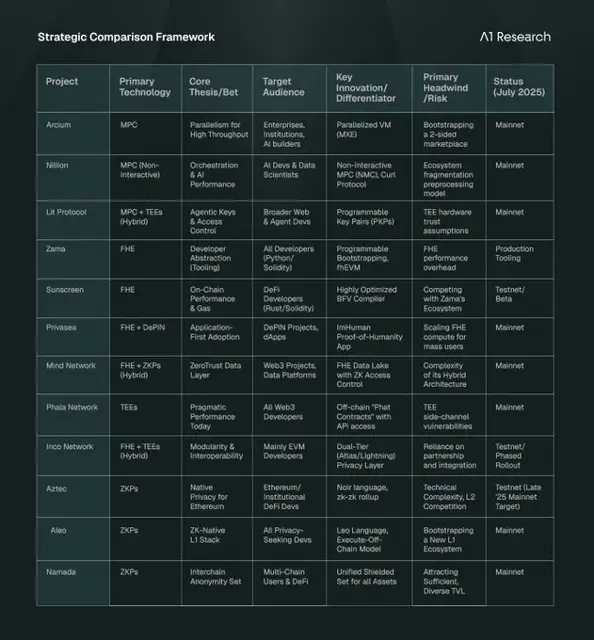
➤ 𝗙𝗛𝗘 𝗖𝗵𝗮𝗺𝗽𝗶𝗼𝗻𝘀: @zama is the dominant force (>$150M funding, 70% tooling market share), creating a universal confidentiality layer via its FHEVM to make any existing blockchain private. @Privasea_ai on the other hand pursues a more application-first strategy, leveraging its "Proof-of-Humanity" identity service to bootstrap an FHE-powered decentralized compute network.
➤ 𝗠𝗣𝗖 𝗜𝗻𝗻𝗼𝘃𝗮𝘁𝗼𝗿𝘀: @arcium targets enterprise-grade throughput with a "parallelized MPC supercomputer" architecture. @nillion innovates with "Nil Message Compute" (NMC) to eliminate real-time messaging, positioning itself as a privacy orchestration layer for multiple PETs.
➤ 𝗧𝗘𝗘 𝗣𝗿𝗮𝗴𝗺𝗮𝘁𝗶𝘀𝘁𝘀: @PhalaNetwork offers a production-ready, decentralized TEE cloud of >30,000 nodes as an Ethereum L2 for high-performance Web3 AI today. @LitProtocol creates a unique niche with its hybrid TEE+MPC network for decentralized, programmable private keys, enabling sovereign agents.
➤ 𝗭𝗞 𝗣𝗶𝗼𝗻𝗲𝗲𝗿𝘀: @aztecnetwork ($119M raised) is building a hybrid ZK-Rollup L2 for Ethereum to become the hub for institutional DeFi. @AleoHQ takes a ground-up approach with a ZK-native L1 architecture for privacy-by-default applications. @namada focuses on multichain privacy with a Unified Shielded Set (USS), a single anonymity pool for all bridged assets.
➂ 𝗦𝘁𝗿𝗮𝘁𝗲𝗴𝗶𝗰 𝗜𝗻𝘀𝗶𝗴𝗵𝘁𝘀 𝗮𝗻𝗱 𝗞𝗶𝗹𝗹𝗲𝗿 𝗔𝗽𝗽𝘀
Looking deeper, we see clear strategic patterns and the emergence of "privacy-native" applications that are simply impossible on transparent ledgers.
➤ 𝗗𝗶𝘃𝗲𝗿𝗴𝗶𝗻𝗴 𝗚𝗧𝗠 𝗦𝘁𝗿𝗮𝘁𝗲𝗴𝗶𝗲𝘀 & 𝗧𝗮𝗿𝗴𝗲𝘁 𝗠𝗮𝗿𝗸𝗲𝘁𝘀: We observe a clear split in go-to-market strategies between general-purpose platforms (incl. @zama or @arcium) and in terms of GTM strategy moreapplication-focused solutions (incl. @Privasea_ai or @LitProtocol). Both are being pulled by the immense economic "gravity wells" of Institutional DeFi and AI, which are the primary drivers of innovation in the space.
➤ 𝗧𝗵𝗲 "𝗣𝗿𝗶𝘃𝗮𝗰𝘆-𝗡𝗮𝘁𝗶𝘃𝗲" 𝗞𝗶𝗹𝗹𝗲𝗿 𝗔𝗽𝗽𝘀: This new stack isn't just for making old apps private; it unlocks entirely new markets:
- For Institutional DeFi: True on-chain dark pools, confidential order books, private lending, and compliant tokenized assets (RWAs) that respect owner privacy, unlocking a multi-trillion dollar opportunity.
- For AI & Agents: Collaborative and fully private AI model training on sensitive data and, most profoundly, the creation of truly sovereign, secure and personalized AI agents. This means bots that can own assets (via @LitProtocol's programmable keys) and execute strategies with verifiable autonomy (via TEE+ZK proofs), shifting trust from corporate promises to cryptographic proof.
➃ 𝗧𝗵𝗲 𝗪𝗶𝗻𝗻𝗶𝗻𝗴 𝗙𝗼𝗿𝗺𝘂𝗹𝗮
Based on our analysis, the projects that will lead this new era will be defined by three principles:
➤ 𝗘𝗺𝗯𝗿𝗮𝗰𝗲 𝗛𝘆𝗯𝗿𝗶𝗱 𝗔𝗿𝗰𝗵𝗶𝘁𝗲𝗰𝘁𝘂𝗿𝗲𝘀: The most defensible systems will be compositional, intelligently layering primitives (e.g., ZKPs verifying TEE computation) to combine their strengths.
➤ 𝗪𝗶𝗻 𝘁𝗵𝗲 𝗔𝗯𝘀𝘁𝗿𝗮𝗰𝘁𝗶𝗼𝗻 𝗪𝗮𝗿: The primary battle is for developer experience. Victory will go to those who best hide cryptographic complexity through elegant languages (like @aztecnetwork's Noir), powerful compilers, and seamless SDKs.
➤ 𝗦𝗼𝗹𝘃𝗲 𝗳𝗼𝗿 𝘁𝗵𝗲 𝗜𝗺𝗽𝗼𝘀𝘀𝗶𝗯𝗹𝗲: Focus on enabling entirely new markets. The true, defensible value lies in building the applications that were fundamentally impossible before this stack existed.
Want to learn more? Make sure to check out our preview article below, and find the full article in the comments.
Full report with deep dive into all 12 in-scope projects, their vision & tech + much more detail and links to a lot of the underlying sources can be found here:
a1research.io/blog/programmable-privacy-the-next-multi-billion-dollar-infrastructure-layer
QUOTING @a1research__
t.co/s18ZNGDnNb
t.co/s18ZNGDnNb
1 more image on X
What came next · since 27 Aug 2025
Since then
Zero has written 1 more piece on Zama since this one.