
Bunker mode explained: AI, ECDSA risk and 6.26M exposed BTC
Post931 words
Justin Drake warned ECDSA could break within months through AI-driven math; 6.26M BTC (31.2% of supply) sits in addresses with exposed keys. Cryptographers pushed back; Vitalik noted lattice schemes share the structured-math risk, favoring hash-based signatures.
Key claims
6.26M BTC, 31.2% of supply, >$500B in exposed addresses
Binance cold storage 83% exposed, Robinhood 100%
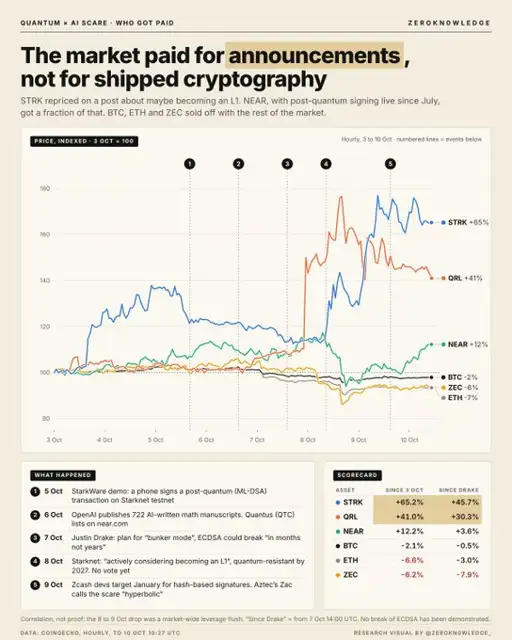
STRK +65% and QRL +41% in a week, BTC, ETH, ZEC down
While half of CT was partying in Singapore, the rest of the timeline was arguing about whether the math behind our crypto wallets could break within months.
Not (just) because of quantum computers, but also AI's rapidly increasing capabilities.
The initial warning came from one of Ethereum's lead researchers on Wednesday.
If he's right, 6.26M BTC might be first in line to be compromised. That's 31.2% of supply, and >$500B in dollar terms, sitting in addresses with exposed keys.
However, it's important to understand that nobody has broken anything so far. But the debate around the threat vector is already moving prices and roadmaps.
Missed what's happening?
Let me explain:
Your wallet is protected by a signature scheme called ECDSA.
It rests on one assumption: nobody can work backwards from your public key to your private key.
We've known since the 90s that a large enough quantum computer breaks that assumption. The comfort was always that such a machine is still years away.
Hence, Ethereum plans to be quantum-safe around 2029. Bitcoin (so far) has no date at all.
That was the whole debate until Tuesday.
What changed?
On the 6th of October, OpenAI published 722 math papers written by an unreleased internal model. Not all of it is verified yet, but it was enough to rattle people who do math for a living.
A day later @drakefjustin, one of the Ethereum Foundation's lead researchers, wrote:
"It is now reasonable to brace for the possibility that ECDSA breaks before qday, in the worst case in months not years."
His logic: if AI can suddenly do decades of math in weeks, it might also find a shortcut that cracks wallet keys on normal hardware. No quantum computer even needed.
So he asked the industry to plan for "bunker mode". Meaning: move funds, starting with the biggest holders, to fresh addresses that have never sent a transaction.
Why fresh addresses?
Because until you spend from an address, the chain only shows a scrambled fingerprint of your public key, so there is nothing to attack.
The moment you sign a transaction, the key is public forever.
That's where the 6.26M BTC figure comes from (based on @glassnode data). Binance's cold storage is 83% exposed. Robinhood's is 100%. On Solana, every address is a public key by design.
But the most important question is: Is he right?
And the answer here might be more nuanced.
Because (as mentioned before), nobody has broken anything yet. So there is no proof.
Meanwhile, most cryptographers pushed back hard. Coinbase's head of cryptography called it "the very definition of FUD", with Ledger's CTO (not sure if that's gud or bad tho lol) and Adam Back saying the same.
The @aztecnetwork co-founder @Zac_Aztec called it "hyperbolic" and warned that the worst reaction would be rushing into newer, less tested cryptography too quickly.
@VitalikButerin landed somewhere in the middle, (re)enforcing the point to NOT scramble to move funds today, but still take AI-driven math seriously.
Then he said the part that I personally think matters the most:
Chains have roughly two families of "post-quantum" signatures to switch to.
- Lattice-based (ML-DSA, Falcon). Compact, fast, the official standard. But built on structured math, a bit like the curves we use today.
- Hash-based (SPHINCS, XMSS). Relies on nothing but a hash function, the simplest building block we have. The catch: signatures get 30 to 120 times bigger.
Vitalik's point: if the fear is AI finding hidden structure in math, lattices are exposed to that same fear. In his view only hash-based holds up against both a quantum computer and an AI shortcut.
Okay.
Now, let's have a look at who is doing what:
- Lattices: @NEARProtocol (live since July), Algorand, Quantus, Sui (planned), Monad (draft)
- Hash-based: Ethereum's roadmap, QRL, Zcash (targeting January), and the STARK proofs under @Starknet
Based on Vitalik's point of view (which is not consensus btw), a chain can hence be safe against quantum computers but still sit in the group he worries about.
Zac (the above-mentioned Aztec founder) counters this, pointing out that nobody actually knows that hashes are safer from AI than curves. It's an assumption rather than a fact.
But enough about the tech side.
Because the market (as you might have noticed) reacted too, and as so often, it bought the loudest story:
- $STRK is up 65% in a week. The catalyst was Starknet saying it is "actively considering becoming an L1" to be fully quantum-resistant by 2027. There is no proposal and no vote yet.
- $QRL, hash-based since 2018, is up 41%.
- $NEAR, which actually has post-quantum signing live on mainnet, is up 12%.
- BTC, ETH and ZEC are all down.
Announcements got paid more than shipped code tho for now.
My take:
ECDSA is most likely not breaking next month, and this week may well look like FUD in hindsight.
But every chain now has to answer how fast it can swap its cryptography if it has to. Chains where you can rotate keys without changing your address (like NEAR, @SuiNetwork, @Algorand and Starknet) have the easy path. Bitcoin, with no agreed plan and a third of supply exposed, has the hardest one.
If you want to be on the safe side, keep long-term holdings in addresses that have never signed a transaction, but don't rush it and fuck up along the way.
Some of the next things I'll watch: Aztec's security roadmap, whether or not Starknet actually migrates to an L1, and whatever comes out of the Ethereum researchers' meeting that runs through Monday.
NFA tho. DYOR.
1 more image on X
What came next · since 10 Oct 2026
Show how the 6 covered assets moved
This explainer walks through how things work without making a call on the token, so price moves since publication are shown as market context.
Covered, no call
Since then
No follow-up pieces on this subject yet. This is the latest take.
Daily closes in USD from DefiLlama and Yahoo Finance. Only a bullish or bearish call in a thesis or market take is tracked; explainers, lists, maps and mentions are neutral context. Not financial advice.