
The Stack Wars: OP Stack, Polygon CDK and Arbitrum Orbit compared
Thread944 words
Argues builders now choose tech stacks rather than chains. Compares OP Stack (optimistic, Superchain), Polygon CDK (zkEVM with proof aggregation layer and POL security) and Arbitrum Orbit (L2s need DAO approval, L3s permissionless), with adopters.
Key claims
Polygon CDK chains settle via an aggregated proof layer amortizing verification cost
Arbitrum L2s on Nitro need DAO ecosystem license, L3s are permissionless
Frame is launching an Orbit-based L2
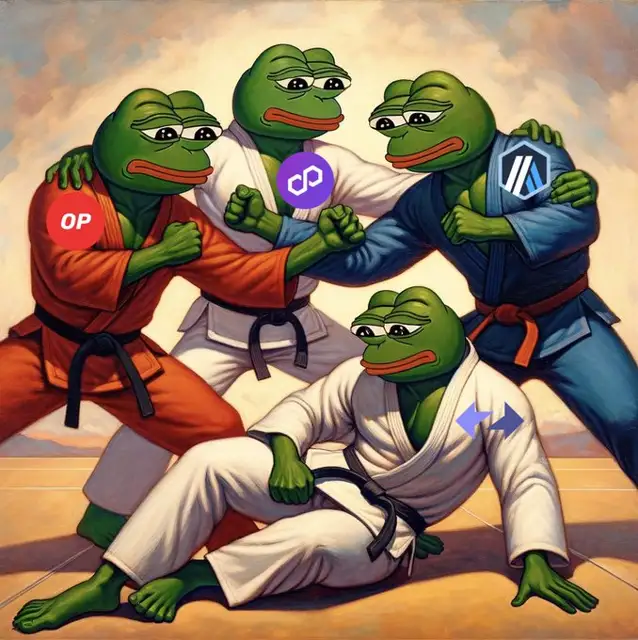
The Stack Wars have begun! ⚔️
Builders don't choose chains to build on anymore, they choose tech stacks!
The battle of these ecosystems is one of the largest in crypto history & will shape the future of Ethereum!
Featuring Optimism, Polygon, Arbitrum, zkSync, Starknet, ++
🧵
1/ Ethereum will scale through rollups and the future is modular.
With big rollup companies allowing for and even promoting permissionless innovation on top of their code base, this trend accelerates.
2/ Being able to build on a well established tech stack abstracts away a large degree of complexity that devs normally face.
Solutions like the OP stack or Polygon's CDK are hence big catalysts that will lead to many projects (both existing and new) to opt for a L2 solution.
3/ Compared to a dApp on a general purpose smart contract layer, app-specific rollups can provide more customizability and hence potential to optimize,
4/ Additionally, rollups that share security with the L1 are easier to spin up and maintain as the need to build and manage a validator set & consensus mechanism is abstracted.
5/ Thanks to a layered design of these tech stacks, builders can customize each modular component of the network architecture.
Including:
🔹 Shared Sequencer Solutions
🔹 Modular Data Availability Layers
🔹 Custom Virtual Machines
🔹 Custom Interoperability Frameworks
🔹 & more
6/ Thanks to the high degree of customizability and the subsequent optimization for specific use cases that this enables, there are entire ecosystems emerging on these different tech stacks.
But let's explore the different solutions and their ecosystems! 👇
7/ OP Stack - @optimismFND
Probably the framework that has gained most traction so far.
The current version of the OP stack is Bedrock, a modular tech stack that enables devs to build within the broader vision of the Superchain.
8/ Under the Superchain paradigm, app-specific L2s based on the OP Stack form one interoperable ecosystem that is powered by shared sequencing and cross-rollup messaging protocols.
9/ While supporting different state validation mechanisms in the future, the OP Stack is primarily geared towards building optimistic rollups that run (potentially customized) EVM implementations.
10/ I have covered the OP Stack in detail in the below thread! 👇
x.com/zerokn0wledge_/status/1716155282257277221
11/ For a brief ecosystem overview, this visualization by @ETH_AllDay is great! 🔴✨
The ecosystem includes:
@optimismFND
@BuildOnBase
@ourZORA
@MantaNetwork
@lyrafinance
@worldnetwork
and more!
12/ If you want to explore the emerging ecosystem of OP chains, check here! 👇
x.com/zerokn0wledge_/status/1716367441721528352
13/ Chain Development Kit (CDK) - @0xPolygon
Another serious contender in the stack wars is Polygon's CDK.
Similar to the OP Stack, Polygon's CDK is focused on L2s
The permissionless framework let's devs build (customized) zkEVM implementations on polygon's codebase.
14/ As a leading innovator in the zk tech space, Polygon currently has the probably most efficient proving system (plonky2, soon 3).
The instant validity guarantees for state transitions & the mathematically ensured execution correctness are definitely among the CDK's benefits.
15/ Learn more about Polygon's high performance zk proof system here! 👇
x.com/zerokn0wledge_/status/1678788769141649408
16/ Validity proof based state validation also comes with benefits with regards to interoperability.
Within Polygon 2.0, an interconnected ecosystem of (app-specific) rollups based on the zkEVM code base and a layered tech stack, all chains are seamlessly interoperable.
17/ This interoperability feature is enabled by a proof aggregation layer, where the proof of execution correctness of all participating rollups is aggregated and settled on Ethereum L1 in one.
18/ As most CDK chains post data to Ethereum or at least post DA attestations back to Ethereum L1, rollups can trustlessly interoerate with each other.
19/ Additionally, the aggregated L1 settlement is very cost efficient, amortizing the cost of proof verification among multiple rollups.
20/ The whole system (including a decentralized sequencer) will be crypto-economically secured by POL that is now officially live!
For more on POL, check @0xPolygon's announcement! 👇
x.com/0xPolygonLabs/status/1717134336104038580
21/ When Polygon first launched the Polygon zkEVM 6 months ago, I also wrote a deep dive on Polygon's zkEVM technology together with @Louround_.
If you're not really familiar with the Polygon tech stack, make sure to check it out! 👇
x.com/Louround_/status/1639323599214616576
22/ Recently the Polygon CDK has started to gain some serious traction with multiple big projects opting to build on the Polygon tech stack.
23/ This includes:
Immutable @Immutable
Idex @idexio
Gnosis Pay @gnosispay
Astar Network @AstarNetwork
Dogechain - @DogechainFamily
Palm foundation - @palmfdn
Nexon - @Nexon
Canto - @CantoPublic
Aavegotchi - @Aavegotchi
Nubank - @nubank
24/ Wirex - @wirexapp
Outer Life - @OuterLife_io
Accentrik - @acentrik_io
Capx - @CapxFi
Powerloom - @PowerLoomHQ
And more ….
25/ Learn more about @MantaNetwork's transition to Polygon's CDK in my deep dive below! 👇
x.com/zerokn0wledge_/status/1714146521917071529
26/ Arbitrum Orbit is a modular framework for building L2s or L3s based on the Arbitrum Nitro codebase.
It offers different DA options and support for EVM and the WASM-enabled Stylus VM.
27/ However, building a L2 on Arbitrum's nitro stack requires DAO approval.
Building L3s on the other hand (as they accrue more value back to Arbitrum and ARB), are permissionless
28/ At @RedactedRes we have recently covered the question of permissionless vs. licensed in the context of rollup tech stacks.
Read up here! 👇
x.com/RedactedRes/status/1716161033260478806
29/ Just recently, @frame_xyz has announced that they will launch a L2 based. on the nitro codebase due to its seamless UX, permissionless fraud proving innovation (BOLD) and support for Stylus (WASM VM).
x.com/frame_xyz/status/1716529884816900563
30/ To be able to do build out this L2, the network focused on creators & collectors had to get an ecosystem license from the DAO first though.
But there are also projects that permissionlessly build on L3 already, including @SyndrHQ, a perpetual futures exchange.
9 more images on X
What came next · since 26 Oct 2023
Show how the 3 covered assets moved
This explainer walks through how things work without making a call on the token, so price moves since publication are shown as market context.
Since then
Zero has written 12 more pieces on Optimism and $OP and $ARB and $POL since this one.
Daily closes in USD from DefiLlama and Yahoo Finance. Only a bullish or bearish call in a thesis or market take is tracked; explainers, lists, maps and mentions are neutral context. Not financial advice.