
Chain abstraction is the modular endgame: ERC-3770, ERC-7683, based rollups
Quote647 words
Surveys Vitalik's proposed fixes for L2 fragmentation (ERC-3770 chain-specific addresses, ERC-7683 cross-chain intents, based rollups) and argues account-level chain abstraction via NEAR and Particle is closest to market.
Key claims
ERC-7683, proposed by Uniswap and Across, introduces cross-chain intents
Based rollups need either fast L1 blocks or slow blocks with fast pre-confs
Account-level abstraction is nearer to market than shared sequencer ecosystems
𝗖𝗵𝗮𝗶𝗻 𝗔𝗯𝘀𝘁𝗿𝗮𝗰𝘁𝗶𝗼𝗻 𝗶𝘀 𝘁𝗵𝗲 𝗠𝗼𝗱𝘂𝗹𝗮𝗿 𝗘𝗻𝗱𝗴𝗮𝗺𝗲
The modular expansion is just starting. 🧱✨
A rollup-centric multi-chain future composed of 1000s of app- and vertical-specific chains is emerging.
So are we done?
According to @vitalikbuterin, not quite yet.
While modularity enables the infra for truly mass adoption ready applications, the Cambrian explosion of L2s also fragments liquidity and introduces UX friction.
Unifying all chains into one composable ecosystem where users don't have to care which chain they're on is the endgame of the modular thesis.
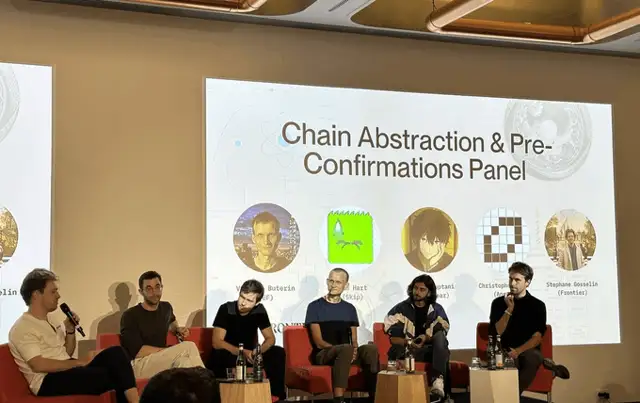
In various conference appearances and Twitter posts, @VitalikButerin has shared his views on how the fragmentation problem can be solved.
In the short-mid term, @VitalikButerin is a strong advocate of two ERCs that aim to simplify cross-chain interactions within the Ethereum (and L2) ecosystem.
💡 ERC-3770:
A standard that simplifies the cross-chain transaction UX by including the chain identifier in the address, clearly indicating the blockchain a certain address is associated with.
In the web2 sense, think of this like an email address that specifies whether the host is Gmail or Protonmail. Similarly, wallet addresses should indicate the chain they belong to, so users know exactly where to send the money to.
💡 ERC-7683:
Proposed by @Uniswap and @AcrossProtocol, this ERC introduces the concept of cross-chain intents to Ethereum.
What that means is that users specify the desired end state of a transaction (e.g., swapping tokens between chains) without worrying about the exact path of execution in between the initial state and the desired end result.
ERC-7683 also defines a standardized structure for cross-chain orders, simplifying the task for relayers (which fill orders) to understand and process these transactions.
Another hot topic in this context is the concept of "based" or L1-sequenced rollups (another Vitalik favourite).
Based rollups enable shared sequencing on the L1 level, which can solve fragmentation within the ecosystem and enable cross-rollup composability.
However, relying on Ethereum's finality times adversely impacts UX on L2s.
To solve this, there are two options:
✦ Fast blocks on L1 and no pre-confs
✦ Slow blocks on L1 and fast pre-confs
Today, Ethereum has slow block times.
Hence, infrastructure projects like shared sequencers and fast finality layers (both in some cases built on @eigencloud) have emerged to provide crypto-economically secured pre-confirmations across chains.
@AstriaOrg is an example of a specialized sequencing layer designed to support based rollups. It features fast block times and single slot finality to abstract the need for pre-confirmations.
While these approaches are promising, they will lead to the emergence of internally interconnected but externally isolated ecosystems of composable chains.
To fully abstract the complexity of the fragmented backend towards the end user and unify liquidity across ALL chains, the problem can be tackled on the account level.
Two major players that follow this approach are @NEARProtocol and @ParticleNtwrk.
@NEARProtocol leverages the concept of chain signatures powered by @eigencloud, which allows users to initiate transactions on their NEAR wallet that will be executed on other chains through MPC nodes.
@ParticleNtwrk on the other hand is provides universal accounts that unify the user experience across all networks with a single balance across all chains and universal gas payments.
So, is this the endgame?
Only time will tell.
According to Vitalik, there is still some infrastructure needed on the Ethereum base layer and current L2 architectures.
What I'm convinced of though, is that modularity needs chain abstraction to unleash its full potential.
How it will be technically implemented remains to be seen.
I'm sure we will see certain ecosystem-specific implementations around shared sequencers and fast finality layers.
Beyond the borders of these ecosystems, and also closer to market already however, account-level chain abstraction solutions seem very promising.
If you want to dive deeper, check my threads below!
✦ Particle Network Deep Dive: t.co/PK47WDIDmh
✦ Particle's Chain Abstraction Alliance: t.co/Pf6PHtm5uS
✦ Chain Abstraction on NEAR: t.co/QLTpdQXRky
✦ NEAR's Chain Signatures: t.co/xtuChUhUVd
🧠 DYOR anon!
QUOTING @zerokn0wledge_
One account. Any chain. Chain Signatures are the UX revolution Web3 needs to reach mass adoption. Enter the modular end-game. Powered by @NEARProtocol and @eigencloud. Alpha-🧵 t.co/yOFCGMGgLT
One account. Any chain. Chain Signatures are the UX revolution Web3 needs to reach mass adoption. Enter the modular end-game. Powered by @NEARProtocol and @eigencloud. Alpha-🧵 t.co/yOFCGMGgLT
2 more images on X