
Why CodecFlow is the most undervalued onchain robotics play
Quote978 words
Bullish call$CODEC+137%since this piece, moved with the callHow it played out ↓Argues Codec is building the AWS/Vercel-style rails for robotics: SimArena (browser simulation), Fabric (per-second GPU mesh), OPTR (runtime) and machine.fun funding. At about $3M FDV, down 90% from launch, the author sees a large gap between shipping and valuation.
Key claims
Robotics venture funding went from under $10B in 2024 to over $50B in 2025
CODEC trades at about $3M FDV, down 90% from launch hype
Co-founder Khalil built LeRobot at Hugging Face
Unitree IPO just kicked off robotics szn.
It's the main vertical to watch in the coming months.
Not just in terms of IPOs tho.
In weeks of research, I identified the probably most undervalued onchain robotics play out there.
Alpha below ↓
Before we dive in, let's set the stage by answering the question "why now" is time for the big robotics bullrun:
Robotics venture funding did a 5x in just one year. Under $10B in 2024, over $50B in 2025, with 2026 projections ranging far beyond that.
Figure raised $1B.
Apptronik $935M.
Galbot $300M.
In Shanghai, Unitree just went public and opened 600%+ above its $22 IPO price at >$150, closed day one up 460% at an almost $50B valuation.
Meanwhile hyperscalers are projected to pour over $500B into AI infrastructure in 2026, with Google alone guiding $180B, and at the @wef in Davos, @elonmusk re-emphasized his prophecy that robots will eventually outnumber humans on this planet.
Yet, there is one part nobody talks about.
Every dollar of that capital flood hits the same wall:
Building a robot in 2026 still works like building a website in 2004. Getting a first scene running in Isaac Sim means an NVIDIA account, an RTX GPU, OpenUSD, URDF wrangling and days of setup before anything moves. That means every robotics project becomes its own island of formats, simulators, datasets and deploy scripts. The team building a warehouse arm rebuilds the same plumbing as the team building a humanoid. From scratch. Every time.
Software had this disease. Then @awscloud, @github and @vercel happened, and shipping went from provisioning servers manually to merely pushing a commit. The companies that built those rails captured more value than most apps built on top of them.
Robotics has not had that moment yet.
But one ambitious team out there is building exactly this.
Meet @codecopenflow.
Will try to keep this concise for now, but I do want to deepen the thesis I outlined here t.co/SpPVcceCC5 already.
So get yourself a coffee and pay attention anon.
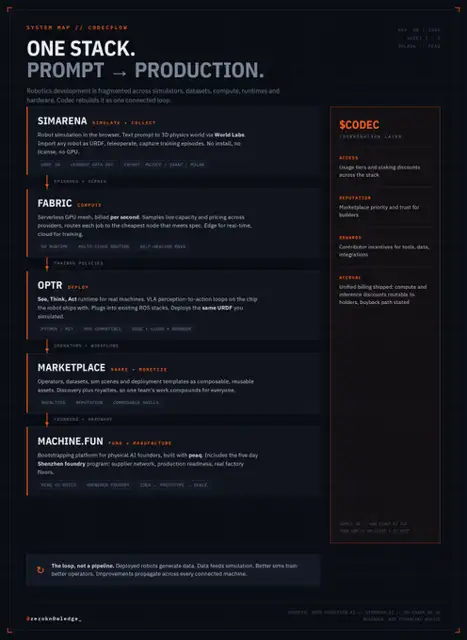
The stack consists of multiple components:
SimArena is the front door and current main focus of the team. It allows robot simulation in the browser, meaning you: describe a scene in text, World Labs generates the 3D physics world, drop in any robot via URDF, teleoperate, and capture training data. No install, no GPUs and it runs on your MacBook. It is not competing with physics engines tho, it sits above them. Datasets export in LeRobot format, scenes export to MuJoCo or Isaac Sim when you scale. Huge, very underappreciated innovation.
Fabric is the metering layer underneath. A serverless GPU mesh billed per second, sampling live capacity across providers and routing every job to the cheapest node that meets the spec. Simulation and training already run through it. This is the revenue engine that might blow minds once public attention shifts here.
OPTR is where simulation meets metal. Open-source "See, Think, Act" runtime: perception in, VLA reasoning, action out, running on whatever chip the robot ships with, and ROS compatible. It deploys the same URDF you simulated, meaning all you need is one file from browser prototype to physical hardware. That unparalleled continuity is the product differentiator here.
But enough on the technicalities.
Bc there is (much) more.
Heard of @machinedotfun yet?
If not, drop a follow and DYOR.
Built in collaboration with @peaq, it closes the loop, providing the funding rails for early-stage hardware/robotics founders. One part of that initiative is "The Foundry", an accelerator program for top builders that connects them with a real supplier network and leaves them in a properly production-ready state.
This matters more than you might think as you read this, and it's the piece everyone misses.
Pretty much every other crypto robotics project stops at software or capital, building only one piece to the puzzle. Codec provides all the tooling and tech you need to build a functioning robot, provides the funding platform, and connects you to the factory floor when you're ready to ship your hardware prototype.
And it compounds. Deployed robots generate data, data feeds simulation, better sims train better operators, improvements propagate across every connected machine. A loop, not just a pipeline.
The pedigree matches the ambition: co-founder Khalil built LeRobot inside Hugging Face Robotics, the open standard half the robot learning world trains on.
Pretty damn bullish, no?
Imo it definitely is.
But to conclude the write-up here, let's quickly talk about the token.
solana:69LjZUUzxj3Cb3Fxeo1X4QpYEQTboApkhXTysPpbpump (live on @solana) is what will coordinate the entire stack: Designed around staking discounts, marketplace reputation and contributor rewards + potential buyback paths from product usage later on (for now that doesn't make sense tho given they're still trying to scale, which means it's a better payoff to re-invest the money they make into the business).
At roughly $3M FDV, down 90% from the initial launch hype a year ago, this is a potentially strong entry setup.
And before you ask "but why is it down 90% in the first place?", hear me out:
This team launched without VC funding. They shipped real products that some competitors with 10x the funding can only dream of. They built in public all along, won a @pumfun hackathon, and survived one of the toughest years our industry has ever seen. Just look at all the projects that died in 2026: t.co/hlYAtdXdNm.
This is NOT financial advice, and I urge you to DYOR. But the divergence between what the team is shipping and what the market is valuing it at rn is way too big imo.
Also not a paid ad, just my thoughts.
Adding more alpha here (that is not even included in my above post).
But if you're into DeAI, you might have an idea of what this could stand for 👀
x.com/codecopenflow/status/2090110376172212238?s=20
And ICYMI, here's a broader overview of the crypto x robotics landscape:
x.com/zerokn0wledge_/status/2088387258940268823
QUOTING @zerokn0wledge_
$UNITREE debuted on Shanghai's STAR Market today and ran from an IPO price of ~$21 to over $150 at the open, settling +460% at ~$125 per share (a ~$48B valuation at close). Robotics szn has officially started, and while retail piles into the now public $UNITREE, smart money is a
$UNITREE debuted on Shanghai's STAR Market today and ran from an IPO price of ~$21 to over $150 at the open, settling +460% at ~$125 per share (a ~$48B valuation at close). Robotics szn has officially started, and while retail piles into the now public $UNITREE, smart money is a
1 more image on X
How the call played out · since 19 Aug 2026
Prices as of 23 Oct 2026This piece takes a view on $CODEC, so that move is read against the call.
+137%
Moved with the call · over 2 months
- At publication
- $0.0027
- Now
- $0.00639
- vs BTC
- +88%
- After 1 month
- +190%
- High since
- +404% 27 Sep 2026
- Low since
- −4.0% 02 Sep 2026
No public market for $UNITREE.
Since then
Zero has written 3 more pieces on CodecFlow and $CODEC since this one.
- machine.fun thesis: why hardware founders may raise on a launchpad over VCBullish call on $CODEC
- CODEC: SimArena at TUM's robo.innovate hackathon with 80+ teamsBullish call on $CODEC
- machine.fun and Codec: financing machines onchainBullish call on $CODEC
Daily closes in USD from DefiLlama and Yahoo Finance. Only a bullish or bearish thesis is read as a call; explainers, maps and mentions are context. Not financial advice.